
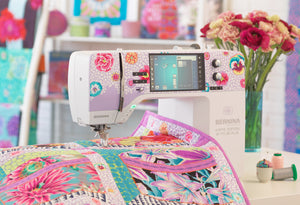

We Love Our Quilting Community
At High Country Quilts we care deeply about community. With our experiences in retail, we know that a store is not only a place to shop but also a place for the community to gather and share. During this busy...


You’re at the quilt shop with a spool of satin in one hand and grosgrain in the other, trying to decide which ribbon will help instead of creating one more fussy detail to manage at the machine. Then you spot the 1 inch width, and the choice starts to make sense.
For quilting, 1 inch ribbon often lands right in the practical middle. It shows off color and texture clearly, yet it is still easy to stitch down neatly on a narrow edge, fold into a hanging loop, frame a label, or add a polished accent that does not crowd your piecing. Quilters do not always get advice written for these jobs, even though ribbon can solve them beautifully.
General craft guides usually talk about bows, gift wrap, and party decor. Quilters need different information. We need ribbon that behaves along an edge, stays manageable under the presser foot, adds interest without extra bulk, and holds up when the project is used instead of admired.
Once you understand what 1 inch ribbon does well, it stops feeling like a pretty extra and starts acting more like a trusty notion in your sewing basket.
It can tidy up a narrow finish where traditional binding feels too heavy, add a soft decorative line to appliqué, and give mini quilts, bags, labels, and hanging details a clean, intentional look. That quilting-specific versatility is easy to miss if you only shop ribbon by color or shine.
You finish a small wall quilt, hold it up, and spot the trouble right away. The edge needs a clean finish, the hanging loop needs to feel sturdy, and a standard binding looks a little too heavy for the scale of the piece. That is often the moment quilters start paying attention to 1 inch ribbon.
One spool can solve several quilting jobs at once.
For quiltmakers, the appeal is not only color or shine. It is proportion. Very narrow ribbon can roll, twist, or disappear against patchwork. Very wide ribbon can cover piecing lines and add thickness in places that should stay neat. 1 inch ribbon sits in a comfortable middle, wide enough to show clearly and narrow enough to stitch with control on mini quilts, labels, decorative bands, and other small details.
The first question sounds simple. “Should I buy satin, grosgrain, velvet, or organza?” But that choice is really about behavior at the machine and on the finished quilt.
A crisp modern project often benefits from ribbon with body that stays flat. A soft appliqué piece may look better with ribbon that bends and drapes more gently. A hanging loop or tie closure needs strength first, because it has a job to do each time the quilt is handled.
Practical rule: If the ribbon needs to carry weight, hold shape, or take frequent handling, choose for performance first. If it is there to add a finishing touch, choose for texture and appearance.
General craft articles often focus on bows, wrapping, and party decorations. Quilters need different answers. We care about whether a ribbon will feed evenly under the presser foot, whether it can finish a narrow edge without a ridge, and whether it adds interest without making the quilt feel bulky or fussy.
In quilting, 1 inch ribbon earns its place because it handles a set of small, precise tasks well:
It works a bit like the 1/4-inch seam allowance in quilting. Not flashy, but wonderfully useful once you understand what it is good at. Keep a few reliable types on hand, and ribbon stops feeling like an extra. It starts acting like part of your regular quilting toolkit.
Choosing ribbon is a lot like choosing flour for baking. All-purpose flour, bread flour, and cake flour can all make something good, but they don’t behave the same way. Ribbon works like that too. Two spools may be the same width, yet one will fold softly, one will hold shape, and one will add texture without much structure.

Satin ribbon is the one many quilters notice first because it reflects light. It has a smooth surface and gives a polished finish to labels, loops, elegant trims, and decorative bands. Single-faced satin has shine on one side. Double-faced satin shines on both, which matters if the ribbon may twist or show its back.
Grosgrain ribbon has a ribbed texture and more body. If you want a bow that doesn’t collapse or a trim that stays crisp, grosgrain is often easier to manage than satin. It feels less slippery and usually behaves well under the machine.
Organza ribbon is sheer and airy. It’s lovely for overlays and soft decorative effects, but it’s usually not my first pick for anything that needs strength or heavy laundering. It adds atmosphere more than structure.
Velvet ribbon brings depth. On wool appliqué, holiday pieces, or richly textured wall hangings, it can be gorgeous. It’s less about utility and more about tactile contrast.
Wired ribbon holds shape because of the fine wire along the edges. That can be useful in bows and sculptural decor, but for most quilt applications it’s better to use with caution. Wire can make stitching awkward, and many quilted projects don’t need that kind of stiffness.
Ribbon didn’t become widely available in today’s range of finishes by accident. A history of ribbon manufacturing notes that loom technology patented in 1745 helped mechanize production, and the Industrial Revolution turned luxury materials like satin into more accessible goods. That same history also notes that modern polyester satin became a top seller, which helps explain why quilters now have easy access to durable satin ribbon in many colors.
The ribbon aisle is broad today because production changed over time. What used to be a luxury textile is now available as an everyday sewing supply.
If you want a simple way to remember the families of ribbon, use this:
That one mental map clears up a surprising amount of indecision at the store.
When quilters say a ribbon “worked” or “didn’t work,” they’re usually talking about four things at once. They mean how it felt in the hand, how it fed under the machine, how it looked after stitching, and how it held up later. That’s why choosing 1 inch ribbon gets easier when you judge it by use, not by looks alone.
Start with material and weave. A smooth satin ribbon behaves differently from a ribbed grosgrain or plush velvet. The surface affects everything from pinning to topstitching.
Then think about stiffness versus drape. Some projects need a ribbon that lies in a soft curve. Others need a ribbon that stays crisp and straight. If the ribbon has to wrap a corner, fold into a flower, or soften an edge, drape matters. If it has to form a hanger or keep a shape, body matters more.
Color is the fun part, but print and finish still affect function. A high-shine ribbon can become a focal point fast. A matte or textured ribbon often blends more easily into piecing.
Last is durability and washability. If the quilt will be used, washed, and handled often, the ribbon can’t be delicate in the wrong way.
For washable projects, polyester satin deserves a close look. Product specifications for 1-inch single-faced polyester satin ribbon report a tensile strength of 50 to 60 lbs, moisture absorption of only 0.4%, and a smooth heat-set finish that reduces needle friction, allowing stitching at over 1000 SPM on BERNINA machines without fraying or drag. In plain language, that means it’s strong, less likely to react to humidity, and easier to sew cleanly at speed.
That doesn’t make it the only choice. It does make it a very sensible one for trims, labels, loops, and quilt details that need to survive real life.
| Ribbon Type | Best Use Case | Durability | Drape | Washability |
|---|---|---|---|---|
| Satin | Labels, elegant edging, decorative bands | Good, especially in polyester satin | Soft to moderate | Good for many projects |
| Grosgrain | Hanging loops, ties, structured accents | Very good | Moderate | Generally dependable |
| Velvet | Texture on wall hangings or seasonal quilts | Moderate | Soft | Best used where laundering is gentle |
If you’re choosing between two ribbons and both seem possible, ask:
If a ribbon makes your block look bulky before you stitch it, it won’t look slimmer after you stitch it.
That one test saves a lot of disappointment.
The nicest thing about 1 inch ribbon is that it can act like trim, structure, or embellishment depending on how you use it. In quilting, that flexibility matters. We often need one small material to do one very specific job, and ribbon can step in beautifully.
Mini quilts, postcard quilts, mug rugs, and quilt labels often have edges that feel too small for a full traditional binding. Ribbon can feel surprisingly elegant in these situations. A smooth ribbon edge adds color and finish without the layered thickness of folded binding strips.
A simple satin ribbon can frame a small embroidered label on the back of a quilt. A textured ribbon can edge a mini wall hanging and make the piece feel complete in one quick pass under the machine.

Some quilts need one extra line of emphasis. Not a flange. Not a pieced border. Just a narrow visual pause between fabrics.
That’s where 1 inch ribbon works beautifully as a faux piping effect, a stitched band between borders, or a clean line over a seam where you want more contrast. It can also become the “lattice” in a ribbon lattice design, especially on smaller projects where wider ribbon would take over the whole composition.
A few favorite uses include:
A narrow ribbon accent can do the work of another border without making the quilt feel heavier.
Quilters often think of ribbon as decorative first, but some of its best uses are practical. A hanging loop on the back of a wall quilt is a classic example. So is a tie closure on a sewing folio, needle book, or fabric journal.
For those jobs, 1 inch ribbon gives enough width to feel secure in the hand without becoming clumsy. It can also work for soft bag handles on lightweight project bags, though I’d still match the ribbon choice to the weight of the item.
Ribbon also shines when you want shape. Folded flowers, layered petals, little bows, prairie-point-inspired accents, and soft sculptural details all benefit from a ribbon that’s already neat at the edge. You don’t have to turn tiny fabric tubes or press miniature strips.
Think of a baby quilt with a few ribbon petals in the center of appliquéd flowers. Or a sewing-themed wall hanging with velvet ribbon stems and satin flower centers. Those touches add interest without asking you to piece one more fiddly patch.
The trick is restraint. One thoughtful ribbon detail often looks more elegant than using it everywhere.
Good ribbon results usually come from preparation, not rescue work. If you cut carefully, secure the ends, and choose the right stitching approach, 1 inch ribbon is very manageable on a sewing machine.

Measure the path where the ribbon will go. If the ribbon wraps around an edge or turns a corner, give yourself extra length so you can trim precisely at the end instead of coming up short. For labels, loops, and ties, cut a sample piece first and pin it in place before committing.
Then deal with the ends. Ribbon frays fast once it starts. Quilters often use a fray-preventing liquid or a careful heat seal when the fiber allows it. The important thing is to finish the cut edge before the ribbon gets handled too much.
Three prep habits help a lot:
For most flat applications, an edge stitch or narrow topstitch works well. Go slowly enough to keep the ribbon centered where you want it. If the ribbon is slippery, a walking foot can help feed the layers more evenly.
Needle choice matters too. A fresh, appropriate machine needle reduces skipped stitches and snags. So does checking that the ribbon lies flat before it reaches the presser foot. Many sewing problems blamed on ribbon are really feeding problems.
If you want to see machine handling in action, this quick demonstration helps:
Curves are where many quilters lose confidence. A straight, firm ribbon may look fine in your hand and still pucker when it has to travel around an appliqué shape or rounded edge.
That’s where bias-cut ribbon earns its reputation. Specifications for a 1-inch bias-cut nylon ribbon note that the wavy edge created by the diagonal cut can increase drape and fluidity by up to 30% compared to straight-cut ribbon, allowing it to follow tight curves without puckering and withstand sewing at 800 stitches per minute on BERNINA machines. In practical quilting terms, it bends more willingly.
Bench tip: If a ribbon fights every curve when pinned dry, don’t force it. Swap to a ribbon with better drape before you sew.
That makes bias-cut ribbon useful for:
A straight-cut ribbon still has its place. But when your design includes curves, drape isn’t a luxury. It’s what keeps the finish smooth.
Ribbon behaves better when you store it like a sewing supply instead of tossing it into a catch-all bin. That sounds fussy until you’ve spent half your prep time pulling one spool free from a tangle.
The cost of messy storage adds up. A 2026 craft-survey summary reports that quilters can lose up to 30% of prep time dealing with tangled supplies like “ribbon birds’ nests,” and that vertical spool holders for 1-inch widths can cut retrieval time by as much as 50% compared with digging through boxes. If you use ribbon regularly, that’s reason enough to set up a better system.
A few methods work especially well in quilting rooms:
For broader ideas on arranging a busy craft room, this guide on how to organize craft supplies has practical systems you can adapt for ribbon, notions, and works-in-progress.
If your quilt includes ribbon, gentle handling pays off. Pretesting is wise when you’re unsure how a ribbon will react to moisture or agitation. For finished pieces, a mild wash cycle and careful drying are usually kinder than rough laundering, especially for decorative trims.
Keep any leftover spool wrapper, fiber label, or product note if you can. Future-you will appreciate knowing what you used.
Reading about ribbon is useful. Handling it is better.
If you want to compare textures, see how much shine is too much, or figure out whether a ribbon has enough body for a hanger or enough softness for an edge, it helps to see real options side by side. That’s especially true with 1 inch ribbon, where small differences in finish and structure change the result on a quilt.
High Country Quilts in Colorado Springs is a strong place to do that kind of hands-on decision-making. As an authorized BERNINA dealer, the shop can also help quilters match technique to machine performance, especially when you’re stitching trims, labels, or decorative accents that need accuracy. Beginners can get guidance without feeling rushed, and experienced quilters can bring in a specific problem and talk through practical solutions.
If ribbon has felt like one of those “maybe someday” supplies, this is a good time to revisit it. The right spool can become a finishing detail, a design accent, or a simple answer to a quilt edge that never looked quite done.
If you’d like help choosing ribbon, testing sewing techniques, or finding the right notions for your next quilt, visit High Country Quilts. You can explore supplies in person, learn from a knowledgeable team, and get support on the BERNINA tools that make precision work easier.
At High Country Quilts we care deeply about community. With our experiences in retail, we know that a store is not only a place to shop but also a place for the community to gather and share. During this busy...

Hi! We’re Adam and Renee Wheaton, the new owners of High Country Quilts! For more than 40 years, we’ve owned and operated vacuum and sewing businesses. Following in Renee’s father’s footsteps after he retired from All Discount Vacuum and Sewing in Colorado...


Leave a comment