

We Love Our Quilting Community
At High Country Quilts we care deeply about community. With our experiences in retail, we know that a store is not only a place to shop but also a place for the community to gather and share. During this busy...


You're halfway through a quilt, your hands are guiding a gentle curve, and the needle suddenly starts racing. You ease off the pedal, but the next stitches bunch into tiny pinpricks. Then you try again, move faster, and leave a long gap that makes the design look uneven. Free-motion quilting can turn a satisfying project into a constant negotiation between your hands, your foot, and the needle.
Sewing machines with stitch regulators are designed to reduce that particular struggle. They sense fabric movement and adjust needle speed so the stitches stay closer to the length you select. That doesn't make quilting automatic, and it doesn't replace good hand control. It changes the relationship between movement and stitching, which can make certain designs easier to manage.
This guide takes a practical approach. You'll learn what happens at the needle, how different regulator systems are built, where setup can become frustrating, and whether regulated stitching solves a problem you have. You'll also see why machine compatibility and hands-on instruction matter as much as the feature itself.
The quilt is spread across the table, the presser foot is lowered, and your right foot hovers over the pedal. You start a loop slowly. The first few stitches look promising. Then your hands accelerate around the curve while your foot stays at the same pressure, and the stitches stretch noticeably. You slow down to regain control, but the needle keeps making small, crowded marks.
That unevenness comes from a basic mismatch. In ordinary sewing, the feed dogs move fabric in a controlled direction, and the selected stitch length helps determine how far the fabric travels between needle penetrations. In free-motion work, you guide the quilt sandwich yourself in any direction. The pedal controls needle activity, while your hands control fabric movement. If those two speeds don't agree, stitch length changes.

A practiced quilter can develop a reliable rhythm, but even experienced makers may find that curves, lettering, dense background fills, and long sessions expose small inconsistencies. Hand fatigue can alter movement. A bulky quilt can drag against the table. A pause to rethink the design can leave stitches crowded in one area and elongated in another.
Practical rule: A regulator can steady the needle-to-fabric relationship, but it can't decide where your hands should go.
That distinction matters when you're shopping. A stitch regulator doesn't improve every aspect of free-motion quilting. It won't create a pleasing motif, remove the need to baste securely, or prevent every skipped stitch. It targets one problem, maintaining a more consistent stitches-per-inch result as fabric movement changes.
The technology has a longer history than many buyers realize. A U.S. patent for a sewing-machine stitch-regulating mechanism was filed on February 28, 1977, while a later optical stitch regulator application was based on a provisional filed December 1, 2004, showing at least a 27-year span between early mechanical work and sensor-based regulation (patent record for a sewing-machine stitch-regulating mechanism).
The buying question, then, isn't just whether regulation works. It's whether more consistent stitch length is worth the price, setup, and machine commitment for your quilting style.
You begin a gentle curve, then your hands slow for a tighter turn. Without regulation, the needle may keep moving at nearly the same rate, leaving stitches crowded together. A stitch regulator coordinates needle movement with how quickly you move the quilt, while you remain responsible for the design and direction.
The process is a feedback loop:
The regulator's specific job is to measure fabric movement and adjust needle speed during free-motion quilting (plain-language explanation of stitch-regulator operation). Move your hands faster, and the needle can respond faster. Slow your hands, and the needle slows too. Pause, and the system is designed to reduce uncontrolled needle movement rather than continuing at the previous rate.
Your foot pedal still has a role. In many regulated modes, pedal pressure sets the available or maximum sewing rate, while fabric movement determines the needle's immediate response. Manual free-motion quilting feels different because pedal pressure more directly controls needle speed. You must match that speed with your hands.

The useful setting is not a fixed motor speed. It is the selected stitches-per-inch setting. Manufacturer guidance describes regulated operation for free-motion quilting, basting, and ruler work. Some models also provide modes such as 2 or 4 stitches per inch for faster basting (BERNINA BSR operating guidance).
This support becomes noticeable when your hand speed changes within one motif. On a tight curve, you can slow the quilt without making the needle race ahead. Along a sweeping line, you can move more quickly without depending entirely on delicate pedal control. The regulator steadies spacing, but your hands still create the shape, scale, and rhythm of the quilting.
The system has limits. If the quilt moves faster than the regulator can process, stitches may become uneven, so controlled motion remains important. The BERNINA BSR stitch-regulation demo on YouTube shows how needle response changes with fabric movement. That demonstration also highlights the buying question: regulation can reduce one coordination problem, but learning the machine's settings and response becomes part of the skill you still need to develop.
Regulators share a purpose, but they don't all sense fabric movement in the same way. The most useful distinction is whether the sensing hardware is mechanical, optical, or integrated into the machine itself.
Older mechanical regulators use a physical wheel or encoder that contacts the sewing surface. As the fabric moves, the wheel turns and communicates movement to the control system. These designs established the basic idea, but they can be sensitive to pressure, surface changes, and contact quality.
They're less common in current quilting purchases. If you're evaluating an older machine or a used accessory, inspect the wheel, cable, mounting hardware, and compatibility information rather than assuming the regulator will behave like a newer system.
Optical systems read movement without relying on the same type of physical wheel contact. That can help when the sensor can maintain a clear view of the fabric surface, although thick seams, changing textures, or poor positioning can still affect performance.
Aftermarket optical units can be attractive because they may let you add regulation to an existing domestic machine. The trade-off is more responsibility during installation and calibration. You'll need to confirm that the accessory port, presser-foot arrangement, sensor clearance, and machine electronics all support the unit.
An integrated regulator is designed as part of the machine's electronics and sensor architecture. BERNINA's home-quilting history includes the Aurora 440, released in 2004 with the BERNINA Stitch Regulator, widely identified as the first home sewing machine to offer stitch regulation for free-motion sewing (history of BERNINA and home stitch regulation).
Integrated systems usually provide a cleaner user experience because the machine, sensor, controls, and presser-foot setup were designed to work together. They can also tie you more closely to a manufacturer's accessories and service network.
| Stitch Regulator Types Compared | Sensor Method | Response Speed | Typical Cost Range |
|---|---|---|---|
| Mechanical | Contact wheel or physical encoder | Dependent on contact and wheel movement | Varies by machine and used-accessory condition |
| Optical or laser-style | Non-contact reading of fabric movement | Designed for rapid movement detection | Varies by machine compatibility and accessory package |
| Built-in | Integrated sensor hardware and machine electronics | Coordinated through the machine's control system | Usually reflected in the price of the compatible machine or system |
All three approaches aim for the same result, more consistent stitches per inch. The technical path matters because it affects setup, reliability, portability, servicing, and the range of machines you can use.
A regulator performs best when the machine, sensor, presser foot, and controls are configured as one system. The setup becomes manageable once you follow the sequence. A loose connection or misplaced sensor can make accurate regulation seem inconsistent.
Check the exact machine model before installing anything. Matching brands are not enough. A system may require a particular jack, presser foot, sensor direction, or accessory connection. Official machine guidance also emphasizes correct installation and operating-mode selection for normal regulated sewing (machine support guidance for stitch-regulator setup).
Secure the sensor unit, then check what it must read. With a contact system, the wheel should rest properly against the fabric or quilt sandwich. With an optical reader, position the sensor according to the machine instructions and keep its reading area clear. Connect the cable or complete the approved pairing process before turning to stitch settings.
A machine may provide several regulated modes. One may coordinate needle movement with fabric travel, while another may suit controlled starts, pauses, or continuous cruising. Set the desired stitches per inch, then select the mode that matches the motion you intend to practice.
Some regulators also include settings for basting or ruler work. Those functions can be useful, but they may change how the machine responds under the foot. Read the machine-specific instructions before treating every mode as interchangeable.
Calibration gives the system a reference for interpreting fabric movement. Follow the procedure for your model, often by moving the quilt sandwich at a controlled pace while the sensor reads that motion. Repeat the process after changing sensor position, fabric arrangement, or another part of the operating setup.
Start with a scrap sandwich rather than a finished quilt. Press the pedal gently and move the fabric in a steady path. The pedal may feel less like a direct speed control and more like permission for the regulator to work within its selected range. Your hands still determine direction, curve, and stopping point. The machine mainly manages the relationship between needle movement and fabric travel.
Make small adjustments, then test again. If stitches skip, inspect the needle, thread path, presser-foot installation, and sensor alignment. If the quilt resists movement, reduce drag around the machine and confirm the free-motion setup. A change in thread can also alter the result, so check the complete setup before assuming the electronics have failed.
Setup insight: Regulation removes one coordination task, but it introduces an equipment-learning curve. Scrap sandwiches give you room to learn whether the system actually supports your motion better than practiced free-motion control.
A stitch regulator earns its place when inconsistent stitch length remains a problem after you have practiced free-motion movement. If your hands already guide the quilt smoothly and your finished work has the consistency you want, regulation may refine your results rather than transform them.
Practice still matters. Quilters can learn to coordinate pedal pressure with hand movement until stitch spacing stays dependable without electronic assistance. That route takes time and attention, but it builds control that remains useful on machines without regulation. A regulator changes one part of the coordination task, not the need to learn the machine and develop a steady quilting rhythm.
The feature becomes more useful when uneven stitching repeatedly affects the work.
A regulator does not steer the quilt for you. You still control direction, tension, needle and thread choices, and smooth starts and stops. The technology supports one coordination task while your hands remain responsible for the quilting path.
Before spending money, identify the specific difficulty you want the feature to address.
The accessory's value depends on the problem it solves. Community reports on Reddit cite roughly $800 to $1,000 for a separately purchased accessory, with dealer pricing varying, and discuss BERNINA compatibility across many 4-, 5-, and 7-series machines (discussion of BSR necessity, compatibility, and accessory pricing). Treat that figure as anecdotal context, not a universal quote. A test drive lets you judge whether the regulator improves your control enough to justify its cost. You are buying a particular setup and operating method, not more consistent stitches.
Start with the machine, not the marketing label. A regulator can help with stitch spacing, but throat space, motor behavior, table support, presser-foot clearance, and overall stitch quality still shape your quilting experience.
Compatibility is the first filter. A regulator may fit only certain models or generations, and a foot system that works with one machine may not transfer to another. Check the exact model number, required accessory port, sensor type, presser-foot requirements, and included cables before comparing prices.
| Choosing a Machine with Stitch Regulator: Key Comparison Factors | Integrated System | Aftermarket Add-On |
|---|---|---|
| Compatibility | Designed for specified machine models | Depends on model, port, clearance, and accessory support |
| Installation | Usually part of the machine's intended setup | May require mounting, cable connection, or calibration |
| Training | Often covered in machine-specific instruction | May require separate accessory guidance |
| Service | Machine dealer or manufacturer network may support the system | Support can involve both machine and accessory providers |
| Portability | Tied to the compatible machine | May move between supported machines, but not universally |
| Upgrade path | May require changing machines for new features | Can preserve an existing machine if compatibility remains suitable |
An integrated BERNINA system can provide a coordinated experience, while a standalone BERNINA Stitch Regulator accessory may make sense when your current machine supports it. High Country Quilts offers BERNINA machines and BSR-related products, including compatible machines and the BSR Foot System CPL, so buyers can compare a machine purchase with an accessory route in one setting.
The listed machine or accessory price is only part of the decision. Ask whether the package includes the sensor, presser foot, mounting hardware, cables, controller, and necessary software or firmware support. A lower initial price can become less attractive if you must add missing parts or pay for repeated troubleshooting.
Training also has practical value. Ask whether the dealer demonstrates calibration, regulated modes, free-motion starts, and common error recovery. Confirm how warranty coverage applies to the sensor and electronics, who handles repairs, and whether the dealer can perform calibration checks or obtain replacement parts.
A regulator won't compensate for a cramped workspace or a machine that struggles with your quilt thickness. Bring the fabrics and batting you use when testing. Try curves, starts, pauses, ruler work, and a design with changing direction.
Software support matters as well. Find out whether stitch counts can be customized, whether updates are available, and whether updates alter the operating process. The best choice is the system you can understand, service, and use comfortably, not merely the one with the longest feature list.
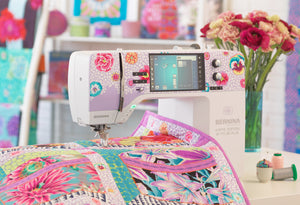
A showroom test should feel like a quilting session, not a salesperson pressing a button for you. High Country Quilts in Colorado Springs offers a place to compare regulated setups with fabric under your hands. The shop has BERNINA models equipped with built-in stitch regulation, including the B 770 QE and B 790, along with standalone BERNINA Stitch Regulator accessories that are powered and ready for test stitching.
A useful test drive includes more than a small fabric square. Ask to work with a longarm frame sample, layered quilt sandwiches with batting, and a project-style quilt panel that lets you practice curves. Those materials reveal how the machine feels when your hands change direction, when the quilt has weight, and when the design requires repeated starts and pauses.
During a scheduled one-on-one session, a quilting specialist can walk you through the controls on the machine you're considering. Focus on the moments that cause trouble at home:
That hands-on time can reveal whether the technology feels supportive or finicky. It also gives you a chance to ask about machine-specific limitations instead of relying on a general description of what regulators do.
The purchase can include complimentary onboarding classes covering free-motion basics and regulator-specific techniques. Ongoing machine servicing, calibration checks, and parts support through the in-house technician can also help you keep the system usable as your experience grows.
If you're upgrading an older machine, ask about a trade-in evaluation. You can also attend monthly free-motion circles and practice on showroom machines, which gives you a low-pressure way to build coordination before committing to a particular setup.
If you're comparing sewing machines with stitch regulators, book a test-drive appointment and bring the fabric, batting, thread, and quilting style you use. High Country Quilts can help you test BERNINA regulated machines and accessories, review onboarding and service options, and decide whether regulation solves your quilting problem. Visit High Country Quilts to arrange your appointment and move from research to real stitching.
At High Country Quilts we care deeply about community. With our experiences in retail, we know that a store is not only a place to shop but also a place for the community to gather and share. During this busy...

Hi! We’re Adam and Renee Wheaton, the new owners of High Country Quilts! For more than 40 years, we’ve owned and operated vacuum and sewing businesses. Following in Renee’s father’s footsteps after he retired from All Discount Vacuum and Sewing in Colorado...


Leave a comment