
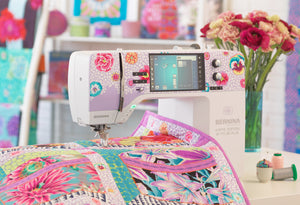

We Love Our Quilting Community
At High Country Quilts we care deeply about community. With our experiences in retail, we know that a store is not only a place to shop but also a place for the community to gather and share. During this busy...


You've sewn what should have been a simple T-shirt seam, only to find a wavy edge, skipped stitches, or thread that snaps the moment the fabric stretches. That experience is frustrating, but it doesn't mean you need to abandon knits or replace your machine immediately. It means the fabric needs a stitch and feeding system that can move with it.
A sewing machine for knit fabrics isn't defined by a single magic label. The useful question is whether the machine gives you the right combination of stretch stitches, controlled feeding, suitable needle support, and adjustable pressure for the projects you want to sew. Once you understand why knits behave differently, the settings become much easier to choose.
A knit T-shirt seam can look fine beneath the presser foot, then ripple or split after the garment is released. The fabric has not failed. Its construction explains the result. Woven fabric holds threads in a crossing grid, while knit fabric is formed from connected loops. Those loops let jersey stretch and recover around the body, and they give rib knit the flexibility needed for cuffs. They also let the fabric shift as the needle and presser foot work.
That movement changes the job of the seam. A straight stitch travels directly from one point to the next, so its thread path has little room to lengthen. Pull the knit across the seam and the fabric expands while the thread resists. The thread may break, or the seam may pop open. A stitch with built-in movement can flex with the loops instead of forcing the thread to carry all the strain.

Wavy seams usually signal a mismatch between fabric stretch and stitch stretch. If the presser foot or feed system draws the knit forward unevenly, the seam can appear flat while sewing and ripple once the fabric is released. An unsuitable needle or stitch may create skipped stitches, small holes, or uneven topstitching.
The fabric's movement is the quality you want to preserve. The machine needs to form a seam that acts more like a flexible spring than a rigid stick. That is why a standard machine can handle some knits with the right setup, while an overlocker becomes useful for fabric that needs more controlled feeding and edge finishing.
Different knits require different levels of control. Stable jersey or interlock may sew comfortably on a regular home machine. Rib knit and highly elastic activewear can shift more readily and demand closer attention to feeding, needle choice, and stitch selection. If the knit's construction is unfamiliar, the cotton pique guide by Cobra DTF explains how structure affects drape, stretch, and handling.
You do not need to learn every machine feature before sewing your first knit garment. Test a scrap from the actual fabric. Sew with a stretch-compatible stitch, then gently pull the seam and inspect its recovery. This small experiment shows how your machine, thread, needle, and fabric cooperate better than a setting viewed in isolation.
For beginner-friendly options, look for sewing machines for easy knit projects with clear stitch selection and practical support. An authorized dealer can also help you decide whether your current machine is enough for the knits you sew, or whether a serger would solve a specific feeding and finishing problem.
A knit seam must bend as the garment moves. A straight stitch forms one short, rigid line, much like a stick laid across a flexible surface. Pull the fabric, and the thread has nowhere to go, so it may snap, pop, or restrict the fabric. A zigzag or built-in stretch stitch travels slightly from side to side. That extra path lets the thread open as the knit expands, then settle back when the fabric recovers.
The modern stretch-sewing guidance explains this basic principle. A narrow zigzag, built-in stretch stitch, or double needle can supply movement on a standard sewing machine. A 4-thread serger or overlocker adds that flexibility while trimming and enclosing the raw edge in the same pass.

A narrow zigzag is a practical starting point on a standard machine because its side-to-side movement gives the seam lateral give without creating a strongly decorative line. The stretch-fabric stitch guide offers settings to try, but the fabric still determines whether the result is right. A knit with gentle stretch may need less movement than elastic activewear.
A lightning stitch, often displayed as a very narrow angled line, serves a similar purpose with a subtle appearance. A triple stretch stitch forms a stronger, more elastic seam by passing through each area several times. It can suit seams that receive repeated strain, though its extra stitching may make later alterations slower.
Machine instructions may offer different starting ranges for zigzag width and stitch length. Treat those values as a testing point, not a guarantee. Fabric weight, stretch, thread, needle, and presser-foot pressure all affect the finished seam. The historical and practical overview of stretch stitches shows how these stitch forms developed to handle elastic fabrics.
Practical rule: If the seam needs to stretch, the stitch needs a way to travel with the fabric.
Cut a scrap large enough to hold comfortably, using the same fabric direction, thread, needle, and seam allowance planned for the garment. Sew a sample, then gently pull across the seam.
Check three results:
Change one setting at a time. Adjusting width, length, tension, foot pressure, and thread together makes the cause of an improvement difficult to identify. A quality machine from a dealer such as High Country Quilts can provide more stitch choices, but testing remains part of the process. The machine supplies the options. Your fabric sample shows which option suits the project.
Stitch selection solves only part of the problem. Knits can stretch before the needle reaches the seam, bunch beneath the presser foot, or ripple as the feed dogs move the layers. The most useful features are the ones that give you control over those physical movements.

Differential feed is most commonly associated with a serger or overlocker. It uses separate front and rear feeding action so the machine can manage how much fabric enters and leaves the stitch area. The purpose is to prevent the knit from being stretched out or pushed into ripples while the seam forms.
A useful way to picture it is two people passing a blanket. If the person at the front moves more material forward than the person at the back removes, the blanket gathers slightly rather than stretching flat. Industrial guidance describes this as “shrink sewing,” with the front feed delivering more fabric than the back feed removes. One example gives 1 cm fed in and 2 cm fed out, producing a seam that becomes stretched and controlled to help prevent rippling. See the explanation of differential feed for stretch-knit seams for the mechanism.
On a regular sewing machine, you may not have differential feed, but you can still improve control by avoiding pressure on the fabric behind or in front of the foot. Let the feed dogs do the work.
Adjustable presser-foot pressure can help when a knit is being compressed rather than guided. Too much pressure may flatten or distort soft fabric. A walking foot can help move multiple layers more evenly, especially when the upper layer tends to lag behind the lower layer.
A walking foot doesn't create a stretch stitch. It addresses a different issue, even feeding. Think of the stitch as the flexible joint and the walking foot as an extra set of hands helping the layers travel together.
Use a needle intended for knit fabric, such as a ballpoint or stretch needle, rather than assuming a general-purpose needle will behave well. A rounded tip can move between knit loops instead of cutting directly through them. The right choice depends on the fabric's weight, stretch, and surface, so keep fresh needles available and test before starting the garment.
A twin needle is another useful feature for hems on a standard machine. It creates parallel rows on the outside while the bobbin thread forms a flexible zigzag underneath. That gives a ready-to-wear appearance without requiring a separate coverstitch machine.
The buyer's lesson is simple. A stretch stitch prevents rigid seam failure, while pressure control, even feeding, and the right needle help the fabric reach that stitch in good condition.
A regular sewing machine can sew many knit garments successfully. A serger makes construction faster and edge finishing more integrated, while a coverstitch machine specializes in hems and visible professional-looking rows. These machines overlap, but they don't perform the same job.
A home machine can handle knits with moderate stretch, about 30–50%, according to this guide to sewing knit fabrics. Highly elastic fabrics often benefit from a serger or overlocker, particularly when you're joining seams and finishing raw edges at the same time.
| Machine Type | Best For | Key Advantage | Limitation |
|---|---|---|---|
| Regular sewing machine | Occasional knit garments, repairs, hems, and topstitching | Uses stretch stitches and familiar controls | Raw-edge finishing requires a separate step |
| Serger or overlocker | Frequent knit construction and edge finishing | Joins, trims, and finishes in one pass | Threading and adjustment require practice |
| Coverstitch machine | Professional-looking hems and sleeve finishes | Creates a flexible hem finish designed for knits | It isn't a general construction machine |
A regular machine is often the sensible choice if you're making occasional T-shirts, simple tops, or knit accessories. You can sew the construction seams with a narrow zigzag or another stretch stitch, then finish hems with a twin needle or suitable machine stitch.
A serger becomes more attractive when you sew knits often, work with highly elastic fabric, or want trimmed and enclosed seam edges as you construct. Its advantage isn't speed alone. The overlock formation wraps the raw edge while allowing the seam to flex.
A coverstitch machine fills a narrower role. It's valuable when hems are central to your projects and you want the look associated with ready-to-wear knit garments. It won't replace a regular sewing machine for zippers, woven details, or many everyday techniques.
If you're also comparing older machines, learning to identify old Singer machines can help you separate historical design features from the stretch controls needed for modern knit sewing. An older machine may be charming and useful, but suitability depends on its actual stitch options, feeding, and condition.
Choose by project, not by the name printed on the box. A machine advertised as a “knit machine” may be less useful than a versatile model with adjustable features that match your fabric and sewing habits.
Start with the projects you can name today. If you want to make occasional jersey tops, prioritize a dependable regular machine with stretch stitches, a clear stitch chart, a suitable needle system, and compatibility with a walking foot or twin needle. If you expect to sew leggings, activewear, ribbed garments, or repeated knit collections, look more closely at serger features such as differential feed, pressure adjustment, and stable tension control.
The BERNINA knit-fabric fact sheet emphasizes adjustable features rather than a generic machine category. That's the right buying mindset because a machine's usefulness depends on the relationship between its controls, your fabric, and how often you'll use them.
A machine is easier to learn when someone can show you how to thread it, select a stitch, adjust pressure, and test a seam. Authorized dealer support also gives you a place to ask about maintenance, accessories, warranty service, and the difference between a regular machine, overlocker, and coverstitch model.
High Country Quilts is an authorized BERNINA dealer offering sewing machines, accessories, training, and machine support. For a sewist buying a sewing machine for knit fabrics, that guidance can be useful because the right choice depends on fabric handling and project frequency, not just the number of decorative stitches.
A scrap of the actual garment knit can reveal problems before they reach the garment. Small habits also protect the fabric. Keep the layers aligned, and let the machine form each stitch instead of forcing the material through.

Cut your sample from the garment area, rather than from a different knit in your stash. Sew in the same direction the finished garment will stretch, then examine the top and underside. Use the narrow zigzag starting point described earlier, and make this test about how the seam behaves under movement.
Check the sample before sewing the garment:
A useful test has two parts. Pull the seam, then let it rest. This shows whether the stitch can extend and whether the fabric has been pushed or dragged during sewing.
Keep your hands light near the presser foot. Pulling from behind changes the seam length, while stretching the fabric ahead of the needle can create a wavy edge even when the stitch setting is suitable. Let the feed dogs move the layers at their own pace unless the pattern calls for controlled stretching.
Use a strong, flexible thread intended for garment sewing, and keep the seam allowance steady. If a hem curls, press it carefully. A narrow strip of fusible tape or wash-away stabilizer can support the edge while you stitch, then remove the temporary support according to its product directions.
For a tidy hem on a standard machine, a twin needle creates parallel topstitching with a flexible underside. Sew slowly around curves, keep the fabric flat, and stop with the needle down before repositioning.
A calm machine is a helpful machine. Slow down, test scraps, and adjust one variable at a time.
A good knit-sewing setup begins with the fabric's movement. Choose a stitch that can extend, let the feed dogs move the layers, select a needle suited to the knit, and test on scraps before sewing the garment.
A regular machine handles many stable or moderately stretchy knits when those choices are correct. Its stretch stitch keeps the seam from breaking as the fabric expands. A serger joins layers and trims the edge in one pass, while a coverstitch machine creates polished, flexible hems. Your fabrics and sewing habits should guide the upgrade.
The same reasoning helps when comparing BERNINA machines, bernette overlockers, and coverstitch options. Focus on controls that solve your actual projects, then seek instruction to turn them into reliable habits.
Visit High Country Quilts to explore BERNINA sewing machines, sergers, knit-friendly accessories, and machine training. Bring project questions or fabric samples, and ask the team to match a setup to the knits you want to sew.
At High Country Quilts we care deeply about community. With our experiences in retail, we know that a store is not only a place to shop but also a place for the community to gather and share. During this busy...

Hi! We’re Adam and Renee Wheaton, the new owners of High Country Quilts! For more than 40 years, we’ve owned and operated vacuum and sewing businesses. Following in Renee’s father’s footsteps after he retired from All Discount Vacuum and Sewing in Colorado...


Leave a comment