

Free Fabric All Year: Our 2027 Fabric Punch Card
November 2–25 only: buy a $200 gift card in either store and get a free yard of fabric every month of 2027.

Most buying advice says the same thing: if you quilt, buy the sewing machine with the biggest throat you can afford. That advice sends people home with a machine that still pinches the roll, or with a frame that does not fit the room. A large advertised width is not the same thing as a usable opening, and it is not a substitute for a table, a feed system, or space to stand.
Throat space is two measurements, not a slogan. Width is how much rolled quilt can sit to the right of the needle. Height is whether that roll clears the underside of the arm. A wide, low harp can be worse for lofty batting than a slightly narrower opening with real vertical room. The rest of this guide is a sizing pillar: match the quilt, measure both dimensions, then match the machine format to the room and the way you sew.
Start with the quilt, not the brochure. A practical sizing guide from Cozy Stitchery sets the needle-to-column opening this way: at least 7 inches for projects up to 45 inches wide, 8 to 9 inches for 46- to 65-inch lap and throw quilts, 9 to 12 inches for 66- to 90-inch twin-to-queen quilts, and 15 inches or more, or a quilting frame, for anything wider than 90 inches. Those figures are the machine's actual opening. They are not the extra inches an extension table paints onto the bed.
| Quilt width | Throat width needed | Machine tier that usually fits |
|---|---|---|
| Up to 45 in (baby, wall and small projects) | 7 in minimum | Quilting-capable domestic machines |
| 46-65 in (lap and throw quilts) | 8-9 in | About the $800 tier |
| 66-90 in (twin to queen) | 9-12 in | $2,500-$3,500 tier |
| Over 90 in (king and wider) | 15 in or more, or a quilting frame | Long-arm or frame system |
Say your next finish is a 60 by 72 inch throw. Flat, the longer side is 72 inches, which already sits in the twin-to-queen band. Once you roll the extra width to pass the needle, you are handling a project in that 66-inch-and-up class, so you want a 9 to 12 inch harp, not a 7 inch compact machine that only suits a wall hanging.
Measure the widest quilt you finish more than once a year. A baby quilt twice a year does not justify a frame. A queen you quilt every season does not belong on a 7 inch harp.
An extension table adds flat support and cuts edge drag. It does not add passage under the arm. If the rolled sandwich already hits the column, a bigger table only gives that stuck roll a nicer place to sit.
Practical rule: Write down your widest quilt, drop it in one row of the table, and shop only inside that band until a rolled test proves you need more.
Before you compare models, pull the machines in that band on High Country Quilts and note which listings publish a needle-to-column number you can check in the store.
Throat space, also called harp space, is the horizontal distance from the needle to the inside of the machine's vertical column. Throat height measures from the bed to the underside of the arm. Width determines how much of a rolled quilt can sit beside the needle. Height determines whether the roll fits without bulky batting pressing against the arm.
Domestic machines spread in the 1860s, when narrow openings made it difficult to move quilts through the machine, and early machine quilting was mostly straight-line work. In 1980, Gammill changed the setup by moving the machine head over a stationary quilt, as described in the Textile Research Centre quilt exhibition text. Domestic machines use a smaller opening, so check the actual measurements rather than relying on a label such as “large throat.”
The 2026 machine roundup from Sewing.com describes compact domestic machines as below roughly 6 inches, versatile quilting machines as around 7 to 9 inches, large-capacity machines as 10 to 12 inches or more, and long-arm systems as about 12 to 26 inches. For lap quilts, 8 inches is a practical minimum. Queen-size work benefits from 10 inches or more, while king-size and wider quilts fall in the 15-inch-or-more band or call for a quilting frame. Compare both width and height: a machine's advertised throat width alone cannot tell you whether your quilt roll will fit.
A wide opening can still be the wrong choice if its height compresses bulky batting. Check both dimensions, then test the roll itself. Take the same sandwich to machines at High Country Quilts and ask to feed it through before discussing price.
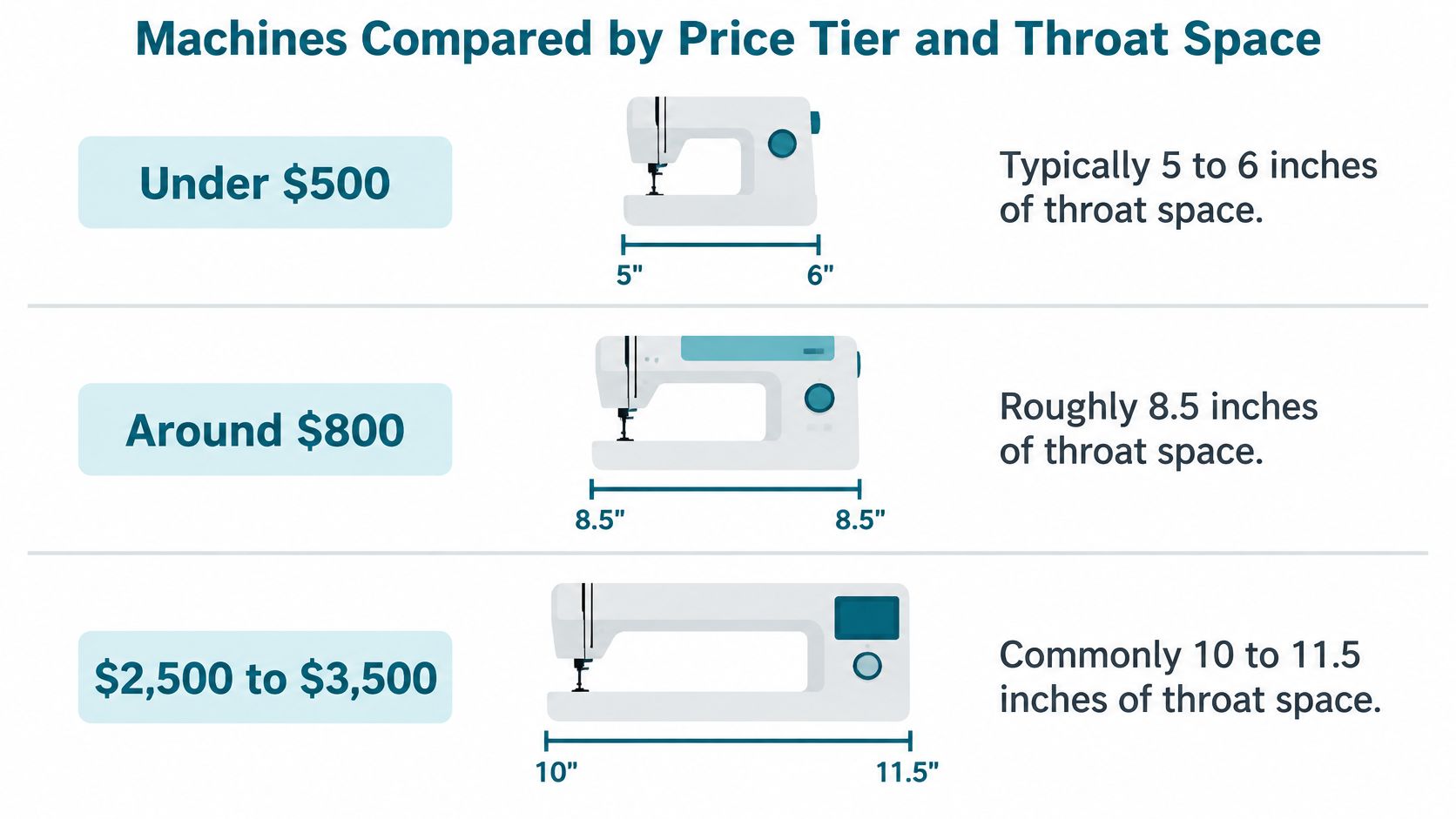
A larger throat is not automatically the better buy. Compare both opening dimensions, the machine's cost, and the work it must handle. The Great Sewing Machine Space Race lays out typical price tiers: under about $500, machines commonly have 5 to 6 inches of throat space; around $800, about 8.5 inches; at $2,500 to $3,500, about 10 to 11.5 inches; and above $4,000, about 13.5 inches. More width gives a quilt roll room to move, but it cannot compensate for poor feeding or a cramped sewing space.
| Machine or tier | Throat space | Approx. price | Main trade-off |
|---|---|---|---|
| Under $500 domestic machine | about 5-6 in | under $500 | small harp strains batting-heavy quilts |
| About $800 tier | roughly 8.5 in | about $800 | workable for lap quilts, limited for queen size |
| Brother PQ1500SL (2024 listing) | 8.6 in wide by 5.7 in high | $799-$899 | harp height is the figure to check against loft |
| $2,500-$3,500 premium tier | 10-11.5 in | $2,500-$3,500 | higher cost; confirm the quoted measurement |
| Janome Continental M7 | 13.5 in | above $4,000 | large footprint and price |
| Janome Continental M17 | 13.5 in | above $4,000 | same throat as M7; verify feed and speed control |
| BERNINA Q16 long-arm quilting | 16 in | dealer pricing varies by configuration | needs dedicated floor area; dealer training matters |
A machine under $500 suits piecing and small quilts. Its 5 to 6 inch opening can compress a batting-heavy sandwich, making free-motion work on larger quilts a repeated exercise in repositioning the roll.
Around $800, an 8.5-inch opening is a more practical fit for lap and throw quilts. It still limits room to maneuver a queen quilt, so do not treat that price step as a universal upgrade.
The Brother PQ1500SL's 2024 listing from QuiltCabana Patterns gives both opening dimensions: 8.6 inches wide by 5.7 inches high, with about 49 square inches of harp volume, a speed of 1,500 stitches per minute, and a listed price of $799 to $899. That combination makes the height especially important. Check your batting loft against the 5.7-inch clearance instead of judging fit by width alone.
Machines in the $2,500 to $3,500 tier commonly offer 10 to 11.5 inches of throat space, a more manageable range for frequent queen-size quilting. Before paying more, confirm that the quoted figure measures needle-to-column clearance, not bed length. A bigger opening earns its cost only if it suits your quilt and your setup.
The table lists the Continental M7 and M17 at 13.5 inches and above $4,000. Treat those as comparison figures, not a reason to choose either machine by width alone. Their matching throat measurements do not establish that their feed or speed controls perform alike; compare those features for the way you quilt.
The BERNINA Q16 is a long-arm quilting machine, not a domestic machine with an extended bed. Its listed 16-inch throat offers more room for large quilt work, while dealer pricing varies by configuration. Budget for the floor space and training the setup requires, not just the machine.
Use the High Country Quilts machine pages to compare listings, then test the quilt roll on the models that fit your price range.
The largest advertised throat is not automatically the best choice. Your room, quilt size, and how often you move the machine all matter alongside its width and height.
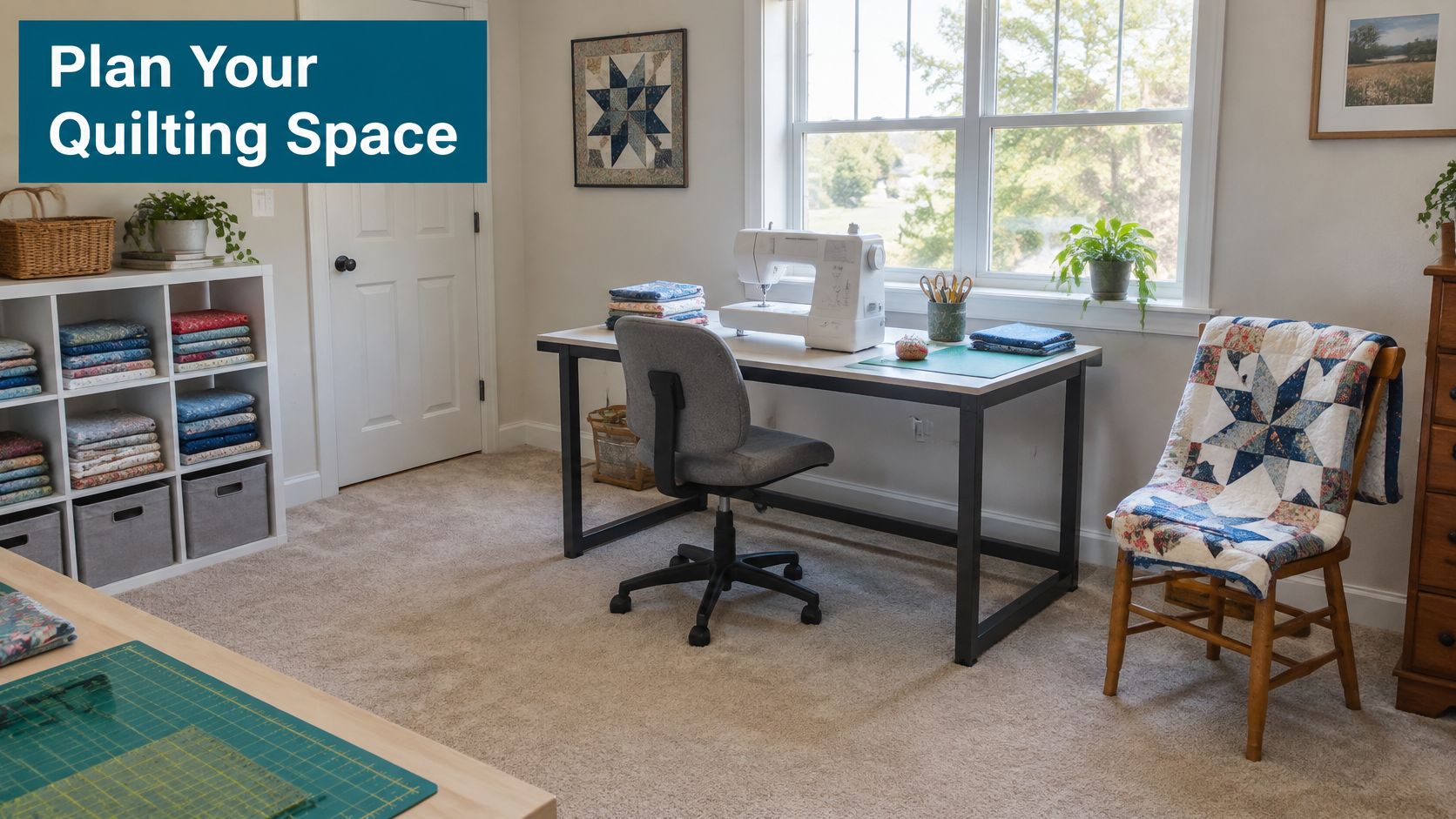
Sewing Trip's space guide recommends roughly 2 to 4 feet of open working space around a quilting machine, about 24 inches in front for loading, and frequently used controls within about 12 to 18 inches. Treat those as room-planning guidelines, not throat measurements. A larger opening cannot make up for cramped access or a work position that leaves your shoulders strained.
| Format | Throat space | Floor requirement | Best fit |
|---|---|---|---|
| Domestic large-throat machine | 8.5-13.5 in | Standard sewing table | Piecing, lap and twin quilts |
| Midarm or sit-down setup | About 8.5-13.5 in for domestic-sized models | Moderate and portable | Seated work with a lighter quilting load |
| Frame-based longarm | About 12-26 in | Substantially more dedicated floor area | Very large quilts and frequent finishing |
Spare-room lap quilter. You make throws, share a wall-mounted table area with a dresser, and piece on the same machine. Choose a domestic harp suited to lap quilts and add an extension table if needed. A frame-based longarm is a poor fit if the quilt or frame would block the closet or leave you no room to work around it.
Class-goer. The machine has to leave the house. Choose a portable sit-down or midarm setup, even if its opening is smaller than a frame longarm's. For this workflow, moving and setting up the machine matter more than buying the widest throat.
Queen-size free-motion quilter. If you finish queen quilts often and have a room that can stay set up, compare frame-based longarms in the 12 to 26 inch range. The 16 inch BERNINA Q16 is one specific longarm option within that range. If a frame will not fit, choose a supported domestic machine in the upper throat band rather than squeezing a longarm into a hallway.
A better table or dual-feed foot may help more than another inch of harp.
Compare domestic and longarm options through High Country Quilts, then measure the room and check the machine's height as well as its width before choosing.
During a test run, load and turn a quilt roll. If you have to keep shoving it, the opening or table does not suit that quilt, regardless of the advertised throat number.
A large throat is useful only if you can control the machine and keep fabric feeding evenly. The listed speed ranges for long-arm quilting machines in Geekfill's long-arm comparison are useful for comparing long-arm models, not domestic machines. For any format, choose a speed you can manage consistently. In free-motion practice, aim for 10 to 12 stitches per inch at a pace you can repeat.
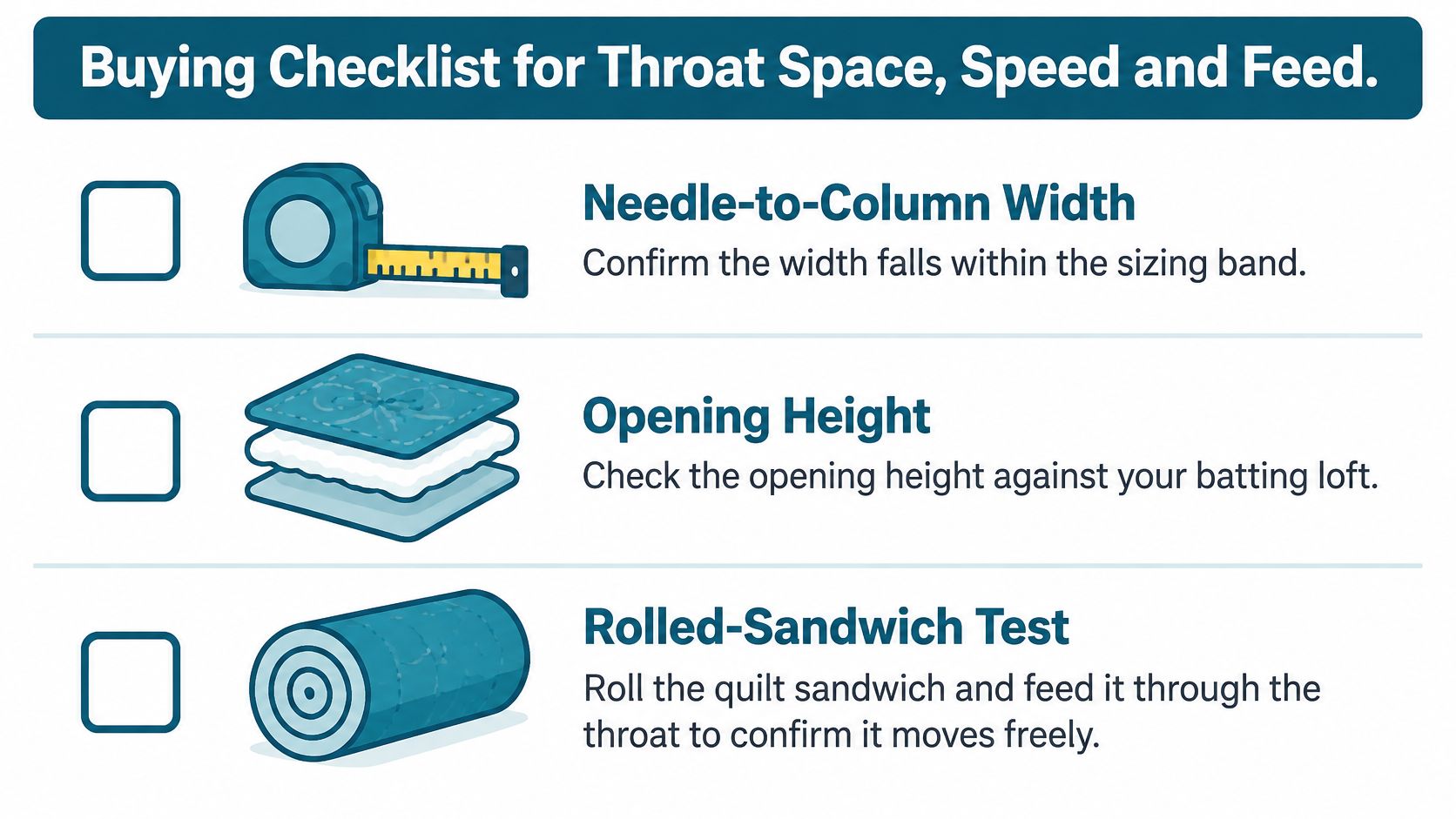
Match width to your band. Place a ruler between the needle and the machine column. If that opening falls short of the range your widest quilt needs, an extension table will not make the throat wider.
Match height to your batting. Slide the batting you plan to use beneath the arm. If it brushes the machine before reaching the needle, the advertised width alone is not enough to judge fit.
Run the rolled-sandwich test. Feed a layered quilt sandwich straight through, then rotate it. Check for drag, foot clearance, and whether you can see the needle. An empty bed can make a machine look roomier than it feels with fabric loaded.
Check the usable speed. Ask for the machine's rated top speed, then sew at a slower setting and increase it until you find a pace you can control. Top speed matters less than keeping stitch length steady while piecing, using rulers, or quilting densely.
Count free-motion stitches. On a practice sandwich, work toward 10 to 12 stitches per inch while moving at a repeatable pace. If your stitches stay even only when you sew at full speed, choose a machine that gives you better control.
Check presser-foot clearance. Lift the foot over a folded binding edge. You need enough room to start a seam across a thick border; a larger throat does not solve limited foot clearance.
Test the feed on three layers. Use a walking foot, dual feed, or another positive-feed feature to keep the backing aligned. Sew a 10 inch line, then compare the lengths of the top and backing.
Check the table setup. A table may be included but still be too small for your quilt. Support the left side of a queen-width piece and watch for dragging. If the edge pulls down, budget for a larger table before paying for more throat space.
Read the service terms. Record warranty length, who handles repairs, and whether training is included. A 13 inch throat cannot make up for service that is difficult to reach when the machine needs attention.
Use the published throat, speed, and feed information on High Country Quilts to shortlist machines, then judge width and height against your quilt and room. A machine should fit the work you do, not win on its largest advertised number.
A large throat number does not guarantee that your rolled quilt will fit or move comfortably. High Country Quilts, in Colorado Springs, is an authorized BERNINA dealer offering training and support for BERNINA machines, along with classes. Use those resources to ask focused questions about a model, but judge its fit against your quilt and room.
Bring a folded quilt sandwich with batting close to the loft you usually use. Compare its bulk with the machine's stated throat width and height, then check these points with the model you are considering:
For lap quilts and a tighter budget, an 8 to 9 inch throat may fit your work; put the savings toward table support and a walking foot or dual feed. For queen-size quilts or frequent free-motion work, favor 10 inches or more, then confirm the opening suits your rolled sandwich. If you take the machine to class, portability and whether it fits outside its cabinet may matter more than another inch of throat. Choose a frame only if your room can accommodate its footprint and working aisle. A 16 inch long-arm is a poor fit when the room cannot spare that space.
Ask the store what training and support are available for the BERNINA model you are considering, and review the warranty terms before buying. Visit High Country Quilts to browse BERNINA machines and ask the team about training and support.
November 2–25 only: buy a $200 gift card in either store and get a free yard of fabric every month of 2027.

Serger and BERNINA Mastery classes, longarm training, bag-of-the-month, Kids Sewing Club and a Highlands Ranch retreat. Here's what's on the calendar in November.

Free gifts, included packages and special pricing on the BERNINA 790 ULTRA, 990, Liberty Editions, L 890 serger and Q Series longarms, now through December 31.


Leave a comment