

We Love Our Quilting Community
At High Country Quilts we care deeply about community. With our experiences in retail, we know that a store is not only a place to shop but also a place for the community to gather and share. During this busy...


You're at the cutting table with a bolt in your hands and a block size already penciled on scrap paper. The birds look bright under the shop lights, then quieter when you turn the cloth toward the window. That shift is the whole decision. A hummingbird print can carry a quilt, or it can vanish the moment you slice it into half-square triangles.
Fabric with hummingbirds is cloth printed or pieced with birds, blossoms, and sometimes feeder shapes. Most bolts aimed at patchwork are cotton. The jewel-like flash is usually a printed gradient, a metallic ink, or a satin-like surface standing in for real shimmer. Before you buy yardage, match the bird's size to the job, then test the dye.
A hummingbird print can look quiet on the bolt and lively in a finished block. Hold a fabric swatch beside a window, then turn it under the room light. A throat that seemed brown may read ruby, while a teal wing can appear nearly black. That shift catches the eye, but it is only one part of choosing a print.
Printed hummingbird fabrics often place birds among flowers on a cotton ground. Some scatter the motifs in different directions; others repeat them with every bill pointing the same way. Vines, feeders, and dark outlines help separate the birds from busy backgrounds, much like spaces between words make a sentence easier to read.
The feathers that inspire these colors have a troubling history. In one week at a London auction house in 1888, about 400,000 hummingbird skins were offered for sale. Dressmakers bought them for hats, dresses, and jewelry because the feathers changed color in the light, according to the Ashmolean Museum's account of Victorian fashion color. That effect, called iridescence, comes from feather structure as well as pigment. Printed cloth imitates it with color and contrast, without using animal materials.
At the cutting table, judge the print by three things: motif scale, project function, and how well its colors hold up in a wash test. A large bird may suit a medallion or fussy-cut panel. A tiny repeat can disappear in a small patch, even if it looks clear on the bolt. Hold a paper window the size of your finished block over the fabric to see which motifs will survive the cut.
Color also affects a print's role. Saturated reds against pale grounds can be striking focal fabrics, while smaller, quieter motifs often work better in connecting blocks. Before cutting, dampen a fabric scrap and press it between white cloth. Check for transferred color, especially with strong reds.
Practical rule: If the bird is hard to recognize through a block-sized window, use the print as a coordinate rather than the focal fabric.
To compare motif sizes, browse current hummingbird quilting fabrics and check each bird against the dimensions of your planned block.
A small fragment at the Pitt Rivers Museum offers a tangible starting point: its record identifies the textile as Peruvian and dates it to the Early Intermediate Period. That date belongs to this fragment, not to an uninterrupted history of hummingbird cloth. The museum record describes the piece and its provenance; it does not establish how long the motif remained in use.
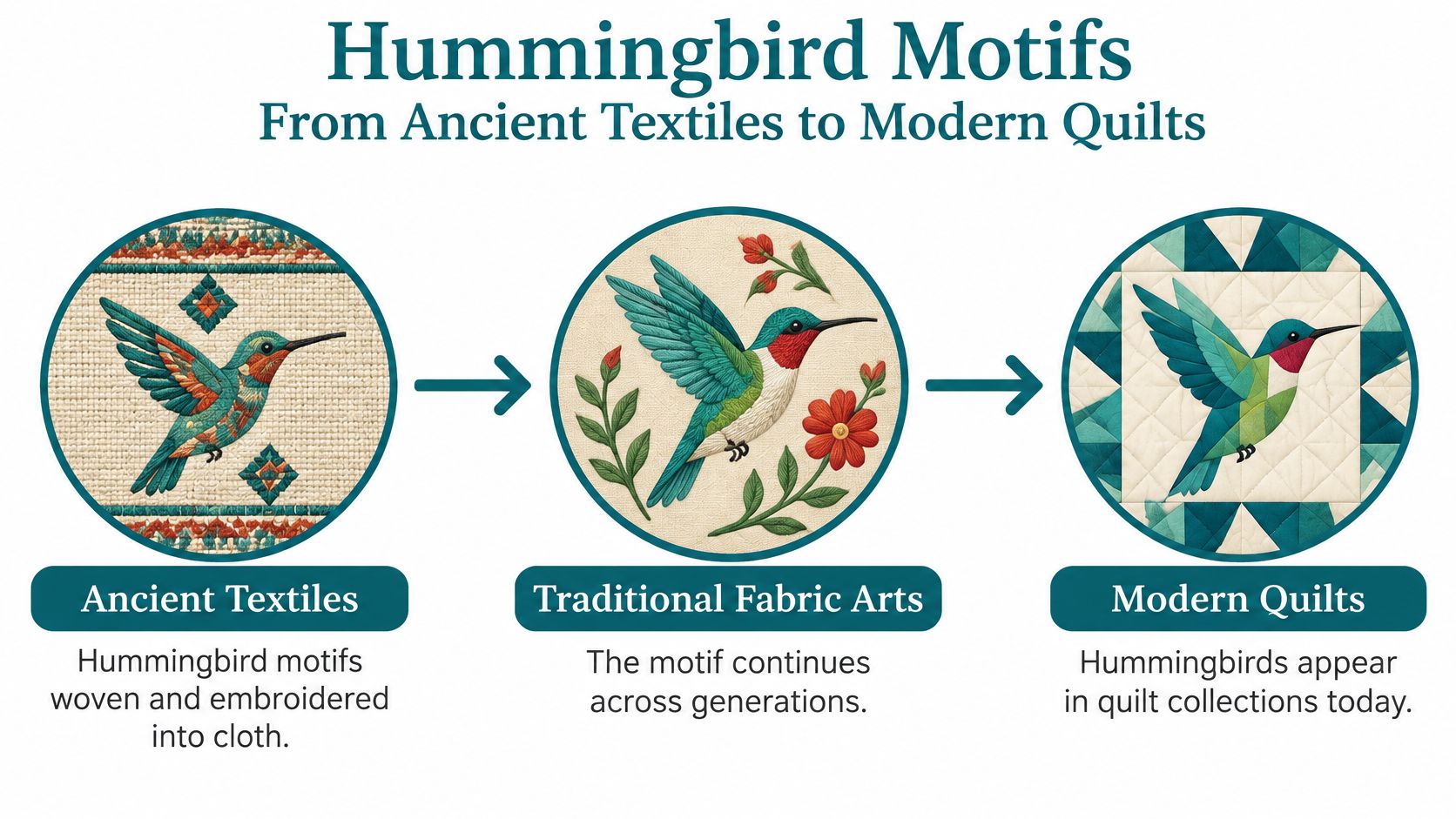
The fragment's ground is described as probably cotton. Its border uses a cross-knit loop stitch, which can resemble knitting at a glance. The embroidery is made with dyed animal fiber, identified as possibly llama, alpaca, or vicuña.
Different fibers absorb dye differently. At the cutting table, that means two prints in similar colors can look quite different once stitched together. A bird's scale, the contrast around its outline, and how the fabric holds its color all affect whether the motif remains clear in a finished quilt.
You can put that lesson to work without identifying every historic stitch. Before cutting, place a motif beside the block size you plan to sew. Does the bird still read clearly when framed by seams? Then wash a small swatch according to the fabric's care instructions and check for color transfer, especially when pairing a saturated print with a pale one.
For a quick comparison, set a pictorial print next to a small-scale coordinate. View both from across the room, then inspect them at the cutting table. The first test shows which motif holds attention; the second helps you judge whether its details will survive your planned cuts.
At the cutting table, a lifelike bird print can look perfect on the bolt and lose its beak in a narrow seam. A playful print may hold its shape through the same cut. The right choice depends on the block size and what the project needs the fabric to do.
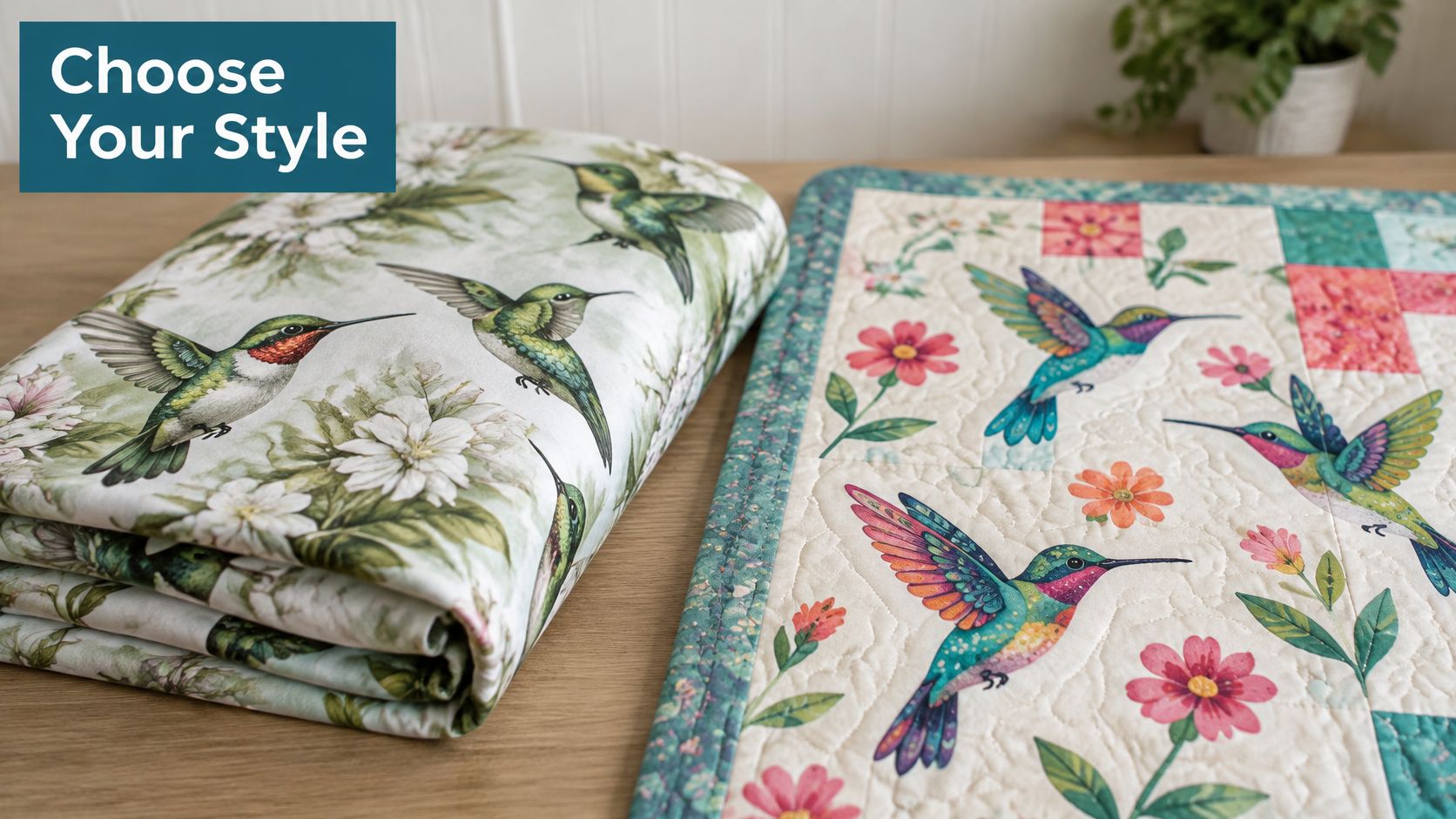
Realistic prints show feather detail, slender bills, and flowers that resemble a bird's natural food sources. They work well in wildlife panels, botanical quilts, or a garment where one bird should draw the eye. Whimsical prints simplify the body, strengthen outlines, or use colors beyond nature's palette. Their clear shapes suit children's quilts, kitchen towels, and cheerful pillows.
A realistic print works like a small illustration: it needs enough space for its details to read. A whimsical bird is more like a bold icon, so it can remain recognizable even when a wing is cropped.
Before choosing, place a repeat over your actual block template. Check what the seam allowance will remove, then see whether the bird still reads.
For realistic birds, the printed pose can add a sense of movement. Hummingbirds can fly forward, backward, sideways, and upward, so a hovering or diving bird can look natural rather than decorative. The Smithsonian National Zoo explains these flight patterns in its hummingbird guide.
A large-scale print may be harder to place, even when it is easy to sew. Test a repeat against the block before cutting: if the face, bill, and wing fit together within the finished shape, the scale suits that block. Then wash a small swatch with a color catcher to check for dye transfer before committing the fabric to a project.
At the cutting table, a hummingbird print has to pass three tests: the motif must fit the pieces, the cloth must suit the project, and the colors must hold up to washing. Quilting cotton usually behaves predictably for patchwork. Cotton lawn is lighter and shifts more easily under the presser foot, while cotton-blend decor cloth is heavier and better suited to items such as pillow covers or runners.
| Fabric Type | Best Use | Key Consideration |
|---|---|---|
| Quilting cotton | Patchwork, appliqué, quilt backs | Stable weave for piecing |
| Cotton lawn | Scarves, light blouses | Soft, lightweight, and more prone to shifting |
| Cotton-blend decor cloth | Pillows, runners, simple totes | Heavier; may need a stronger needle |
Quilting cotton's firm hand helps blocks keep their shape. For precise piecing, a 60/12–80/15 Microtex needle is commonly recommended in this guide to quilting cotton characteristics. Check the needle and fabric together on a scrap first. If stitches pucker or the needle leaves visible holes, adjust before sewing the project.
Motif scale matters as much as fabric type. Hold a repeat over your block template and check whether the bird's head, bill, and wing will fit inside the finished piece. A small print can keep its character in narrow patches; a large bird may need a wider block or a single uncut panel. That simple test can save a favorite motif from disappearing into seam allowances.
Choose one color from the bird, then use it to guide your supporting fabrics. A neutral ground can keep a ruby or copper throat distinct, while a solid or tone-on-tone blender in a wing color adds quiet support. Lay the fabrics beside the print in daylight. If the bird becomes hard to see, choose a calmer coordinate.
Before cutting the full project, wash a small swatch with a piece of white cloth. Check both fabrics afterward: the print should retain its color, and the white cloth should stay clean. Textile colorfastness tests assess these two effects, color change and staining of adjacent fabric, as summarized in EuroLab's overview of textile colorfastness testing. Follow the fabric maker's care instructions, since fiber blends and finishes can respond differently to washing.
A printed cushion near a kitchen rug also calls for care suited to each textile. These rooster rug care tips offer a useful reminder that printed home fabrics and rugs may need different cleaning methods.
At the cutting table, treat the print like a photograph at a job interview. Where will the bird sit, how close will eyes get, and which color already survived your swatch check?
A large motif earns the center. Set it as a medallion and let narrower borders carry the smaller coordinates, so one face stays whole instead of landing across a seam. Repeating floral blocks can earn their place: hummingbirds may need to feed about every 15 minutes because of a very high metabolism, they ride out the night in torpor, a hibernation-like pause that saves energy, and before long migrations they can nearly double their body weight in fat, as described in Smithsonian notes on hummingbird survival. A feeder panel, a pale day row beside a dark night row, or one bloom repeated like a route turns behavior into layout.
For totes, blouses, and scarves, direction is the trap. Hold the folded fabric to the pattern piece: bills should point up on the bag front and on both bodice panels, because one upside-down bird reads louder than ten right side up. Scarves twist, so choose a tossed scatter or accept that some birds fly sideways. Use lighter cotton for drape and a sturdier cotton for a tote that gets dropped in the car.
Runners, pillow covers, and wall hangings are forgiving because you control the top edge. Cut the hero bird first, then plan around what remains. If the red throat left color on white in your earlier swatch check, keep it off a sofa pillow that faces damp hands and save it for a wall piece.
Scraps from a pictorial print still have color, even when the bird is gone. A child can use those bits long before they look like a quilt block.
If the cutoff pile is growing, you can turn fabric leftovers into kids' crafts instead of forcing every scrap into a seam. Sketch the finished size before shopping; a nine-inch bird cannot shrink politely into a coaster.
A student once brought me a finished quilt top with a pink shadow where a cream background used to be. The red hummingbird had bled on its first wash, and the damage was already set. She had trusted the words "machine washable" on the bolt, but those words describe the base cloth, not the dye sitting on top of it. Reds, greens, deep blues, and the dark outlines around a printed bird are exactly the colors most likely to move onto a pale ground.
Think about dye the way you'd think about loose glitter on a card. Until something rubs or wets it, you can't tell whether it will stay put. The Canadian Conservation Institute colourfastness test gives you that rub-and-wet check under controlled conditions. The method is simple: test every colored fabric, thread, repair, and embellishment on its own, first with plain water, then with the detergent solution you plan to use. A clean blotter is a clue, not a guarantee, and University of Nebraska–Lincoln guidance makes the same point: if any color appears on a white cloth, stop before that fabric ever meets a machine.
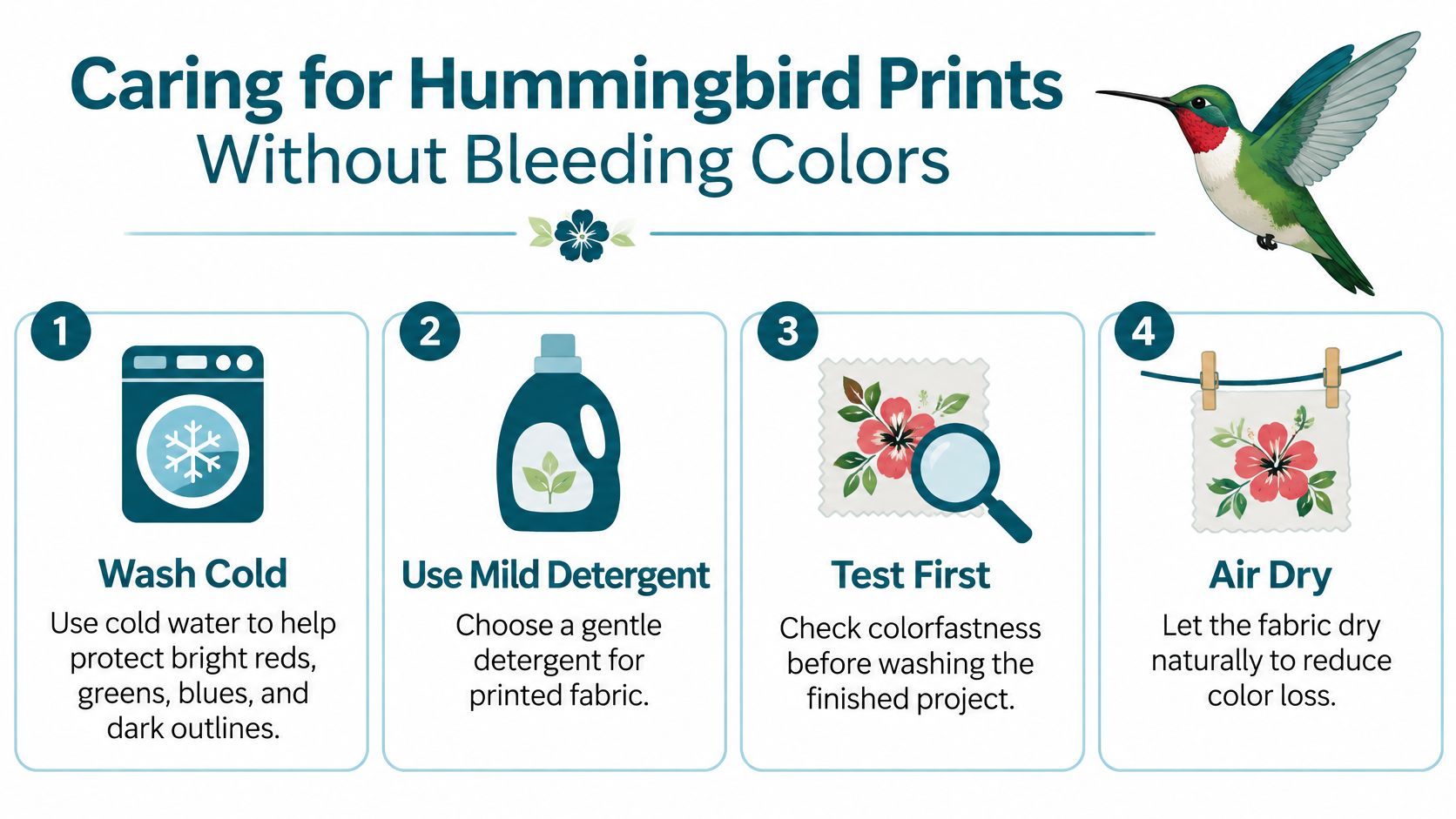
Air drying beats a hot dryer for these prints. Heat can set a stain you still had a chance to lift, and it can dull the printed shimmer you bought the fabric for.
Gather your blotter cloth and mild detergent before the first wash, not after a bleed. The test takes minutes at a cutting table. Undoing a pink background takes far longer.
You have two ways to source this cloth, and they answer different questions. Online browsing is fast for comparing repeats and checking widths. It cannot show you how a ruby throat shifts between daylight and a kitchen bulb. In a shop, you can drape the bolt, cut a fat quarter, and lay one bird over your block template before you commit to yardage.
A shop visit works like a fitting. You are not buying yet. You are checking whether the bird fits the block, whether the cloth suits the job, and whether the dye behaves.
High Country Quilts is a quilting and sewing shop in Colorado Springs carrying quilting cottons, seasonal collections, and precuts, along with classes and community events where you can try a pattern alongside other makers. Staff can match a print to a medallion, a tote, or a runner and talk through a wash plan before you leave. One option on the shelf and online is SF Hummingbird Multi Digital Cuddle 60in Wide, a hummingbird cloth sold by the yard at a 60-inch width. Cuddle has a different hand from quilting cotton. Treat it as a backing, a throw, or a pillow face, and reach for a tight plain-weave cotton when the job is piecing.
An online cart cannot hand you that swatch. A local class can, and it can show you whether your seam allowance is eating the bill of the bird. If you are comparing machines while you are there, an authorized BERNINA dealer on site is a practical stop for needle and tension questions on pictorial cotton.
Come in with one project, one block size, and one color you are worried about. That is enough to leave with cloth you can sew.
At High Country Quilts we care deeply about community. With our experiences in retail, we know that a store is not only a place to shop but also a place for the community to gather and share. During this busy...

Hi! We’re Adam and Renee Wheaton, the new owners of High Country Quilts! For more than 40 years, we’ve owned and operated vacuum and sewing businesses. Following in Renee’s father’s footsteps after he retired from All Discount Vacuum and Sewing in Colorado...


Leave a comment