

We Love Our Quilting Community
At High Country Quilts we care deeply about community. With our experiences in retail, we know that a store is not only a place to shop but also a place for the community to gather and share. During this busy...


You're standing in front of a wall of thread, comparing cotton, polyester, weights, colors, and labels that seem to assume you already know the difference. One spool promises strength, another a soft finish, and a third looks perfect for quilting lines you want everyone to notice. The confusion is understandable. The best quilting thread isn't one universal product. It's the thread that matches your fabric, technique, machine, and desired stitch visibility.
A useful starting point is simple: decide what the thread needs to do before you decide what it should be made from. Piecing usually calls for a smooth, fine thread that disappears into seams. Machine quilting may need a stronger or more visible thread. Hand quilting rewards a different feel altogether, while binding benefits from a balanced thread that can tolerate handling without overpowering the edge.
| Project goal | Practical starting point | Why it works |
|---|---|---|
| Piecing | 50 wt cotton | Creates flat, less noticeable seams |
| Subtle machine quilting | 50 wt cotton or polyester | Balances definition and restraint |
| Visible quilting lines | 40 wt | Gives the quilting pattern more presence |
| Fine detail or appliqué | 60 wt or finer | Recedes into the fabric |
| Bold decorative stitching | 12 wt | Produces strong visual texture |
| Traditional hand quilting | Cotton | Offers a natural feel and controlled stitch definition |
| Hard-wearing utility quilt | Polyester or a blend | Prioritizes strength and reduced maintenance |
The thread aisle becomes simpler to approach when you replace “Which brand is best?” with “What job am I asking this thread to perform?” That shift prevents a common beginner mistake, buying a specialty thread for a project that really needs an everyday workhorse.
For piecing, your priority is seam accuracy. The thread should help fabric layers join neatly without adding unnecessary bulk. A 50 wt thread is the dependable default because it keeps seams relatively flat while providing enough visibility for you to check stitch quality.
For machine quilting, decide whether the stitching should blend into the surface or become part of the design. Matching thread creates texture without making the quilting lines dominant. A contrasting color or heavier weight turns the quilting pattern into a visible feature.
Hand quilting changes the decision again. Your fingers feel the thread as it passes through the quilt layers, so surface feel and controllability matter as much as machine performance. Cotton is often a comfortable traditional choice, particularly when you're working with cotton fabrics and want a soft, matte result.
Binding sits between construction and decoration. The thread needs to hold the folded edge securely, but it shouldn't create a bulky ridge or draw attention away from the binding fabric. A versatile cotton thread is often a sensible starting point, although a durable polyester can suit a quilt that will receive constant handling.
Practical rule: Choose visibility first, then choose fiber and weight. The thread's job should determine the spool, not the other way around.
Before buying, answer three questions:
For a more detailed look at these choices, read this guide to choosing thread for machine quilting. It's especially useful when you're moving from piecing into free-motion or other machine quilting techniques.
The history of cotton thread helps explain why quilters still value it. Manufactured cotton thread was available to hand sewers in the United States and Europe by 1800, wooden spools appeared in 1820, and sewing-machine adoption in the 1840s increased demand for stronger, more consistent thread. Mercerization, developed at the beginning of the 20th century, made cotton thread stronger and smoother while helping it accept dye more readily. Polyester thread arrived in 1942, followed by cotton-wrapped polyester in the late 1960s, creating the natural-fiber versus performance-fiber choice quilters still weigh today. These historical milestones are described in this history of quilting thread.
Fiber affects how thread feels, feeds, wears, and interacts with fabric. You don't need to memorize every manufacturing detail, but you should understand the practical difference between 100% cotton, polyester, and cotton-wrapped polyester or other blends.
Cotton remains the traditional partner for cotton quilting fabric. It has a natural hand and a soft, generally matte appearance that blends comfortably into a cotton quilt. Its weakness is that it produces more lint than continuous-filament polyester and may break sooner when exposed to high stress or aggressive abrasion.
Polyester is the modern performance option. Its continuous-filament construction is commonly associated with higher strength, strong colorfastness, and low lint, which can help keep a machine cleaner. That strength brings a trade-off: polyester's greater abrasion resistance may be less forgiving to cotton fabric over time, especially when the quilt receives sustained wear.
Blends occupy the middle ground. Cotton-wrapped polyester gives you a polyester core for strength and a cotton exterior for a more familiar feel and appearance. It can be useful when you want a compromise, but all-cotton and all-polyester threads usually offer more predictable behavior because the fiber content is consistent throughout.
| Fiber Type | Strength | Lint | Best For | Feel |
|---|---|---|---|---|
| 100% cotton | Moderate and compatible with cotton fabrics | More than continuous-filament polyester | Piecing, hand quilting, traditional and heirloom finishes | Natural, soft, often matte |
| Polyester | High and resistant to breakage | Low when made with continuous filament | Heavy-use quilts, machine quilting, colorfast projects | Smooth, sometimes slightly more lustrous |
| Cotton-wrapped polyester | A practical balance | Depends on construction and quality | Quilters seeking a compromise between grip and strength | Cotton-like surface with a stable core |
The fiber of your fabric still matters. Cotton thread is a natural fit for a quilt made primarily from quilting cotton, while polyester can make more sense when the project combines materials that behave differently or needs extra resistance to repeated handling. Before selecting thread, review the basics of how to choose quilt fabric, because fabric weight, weave, and fiber content influence how the stitch will sit.
Choose cotton when you want the thread to feel integrated with the quilt and age in a traditional way. It's especially suitable for piecing, hand quilting, and a show quilt where a soft surface and understated stitch appearance matter.
Choose polyester when strength, color retention, and lower machine maintenance matter more than a strictly traditional finish. It's a logical option for a quilt that will be washed often, used by children, or quilted at speed on a longarm.
Choose a blend when you're testing a middle path or working with a machine and fabric combination that benefits from both surface grip and core strength. Whichever fiber you select, consistent quality and a clean, even finish matter more than choosing a fashionable label.
The broader cotton sewing-thread market shows why specialty characteristics matter to buyers. A 2025 market overview projects worldwide cotton sewing thread volume to reach 489K tons by 2035, with market value rising to about $3 billion, while volume grows at a 1.3% CAGR and value grows at a 3.0% CAGR. In the United States, another overview places the cotton sewing-thread market at 30K tons and $148 million in 2024, with projected volume growth of 0.1% CAGR and value growth of 1.8% CAGR through 2035. Those figures describe the broader sewing-thread category, not quilting alone, but they support a useful observation: buyers increasingly distinguish thread by finish and performance rather than treating it as interchangeable bulk material. See the cotton sewing thread market overview for the cited market context.
A thread label can seem backward when you first read it. The key rule is simple: a higher weight number generally indicates a finer thread. A 50 wt thread is finer than a 40 wt thread, while a 60 wt thread is finer than both. Treat the number as a guide to how much thread will appear in each stitch, not as a measure of strength by itself.
Weight affects stitch visibility, seam bulk, needle pairing, and machine tension. Heavier thread puts more material through the needle and fabric, so it may require a larger needle and careful tension adjustment. Finer thread can settle into the fabric and reduce bulk, though it may not provide enough visual presence for quilting lines intended as part of the design.
50 wt is the workhorse. It suits piecing and general quilting because it keeps seams relatively flat while leaving enough stitch definition to check your work. If you are buying a first quilting thread without a fixed preference, 50 wt gives you a useful starting point. Pair it with a needle appropriate for the thread and fabric, then test the seam or quilting pattern on a scrap sandwich.
40 wt makes quilting more visible. Choose it when you want stitching to outline a motif, show free-motion movement, or add presence to a larger design. Because it places more thread in each stitch, check that the needle carries it cleanly and that the upper tension does not pull the bobbin thread onto the surface. Decorative quilting and topstitching often benefit from this added definition.
60 wt supports delicate work. Its finer profile recedes in appliqué, fine quilting, and other projects where the fabric or stitched design should remain the main focus. A fine bobbin thread can also reduce bulk, but the result depends on your machine's tension and the particular thread construction. Test both sides of the quilt before committing to a full project.
The relationship between weight and appearance is summarized in this quilting thread weight guide. A separate thread-weight reference for quilting projects also identifies 50 wt as a common choice, 40 wt as more visible, and 80 wt as suited to delicate detail.
Suppose two quilts use the same fabric and quilting pattern. With 50 wt thread in a closely related color, the texture may show mainly when light crosses the surface. Change to 40 wt in a contrasting color, and the same pattern becomes a graphic feature. A finer thread preserves the stitched texture while allowing the thread itself to recede.
Use this scale to match weight to the effect you want:
For piecing, start with a finer, flatter thread when seam bulk matters. For quilting, select the weight according to whether the stitches should blend into the surface or announce the pattern. For binding, test the thread against the folded edge and finished side, since a thread that looks subtle on the quilt top may become more noticeable along the binding. A small practice sample reveals visibility and tension problems before they spread across the quilt.
A spool that's perfect for piecing may be the wrong choice for bold quilting, even if both tasks use the same fabric. The most useful recommendation starts with the finished effect you want: blended, visible, or function-first.
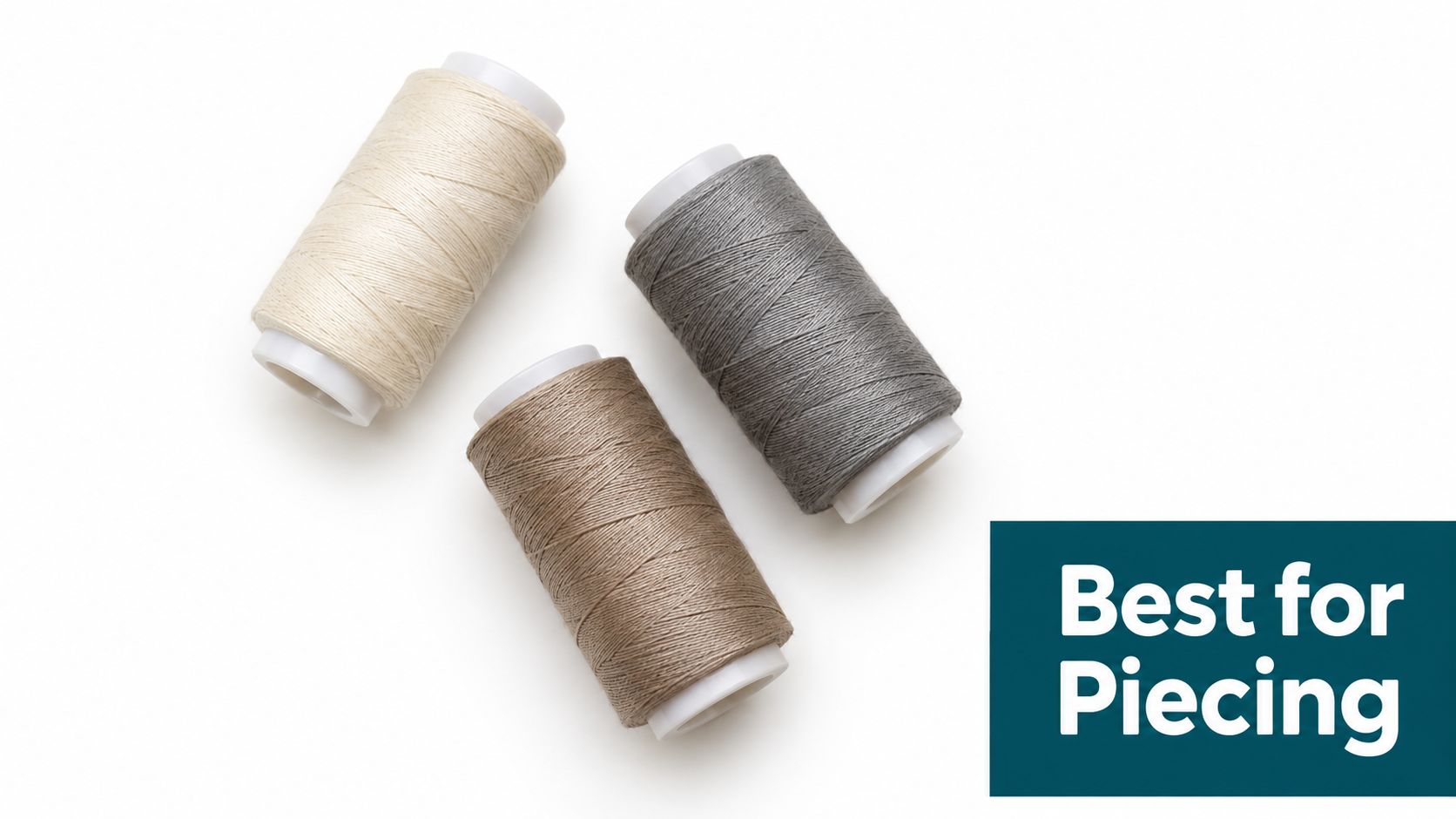
For piecing quilt blocks, begin with 50 wt cotton when you're working with cotton quilting fabric. It produces a neat seam without making the seam allowance unnecessarily thick, and a neutral color can recede into the seam. Choose a high-quality polyester instead if you prefer its smooth feed, lower lint, and extra strength.
A 50 wt thread also suits everyday machine quilting when you want the quilting pattern to support the fabric rather than dominate it. Cotton gives a traditional finish, while polyester is useful when the quilt will face demanding use. A cotton-wrapped polyester can serve as a compromise, although you should test it before committing to a full quilt.
Explore cotton quilting thread options for piecing and everyday sewing.
A show or heirloom quilt often benefits from 100% cotton, particularly when you want a soft, matte stitch that harmonizes with cotton fabric. Select a matching or gently related color for understated texture. If the design depends on the quilting lines, a 40 wt cotton can make the pattern more legible without the bold effect of a much heavier decorative thread.
Hand quilting generally favors cotton because its natural surface gives you a controlled, traditional feel as you pull stitches through the layers. Work slowly and judge the thread against a small quilt sandwich before beginning the main piece.
For visible decorative lines, 40 wt is a practical starting point. It provides more presence than 50 wt and works well when the quilting design deserves attention. For emphatic embellishment, 12 wt creates much bolder lines, but the larger thread usually demands a compatible needle, suitable tension, and a machine that handles the combination comfortably.
A variegated thread can add movement without requiring a complicated stitch design. The color changes become part of the quilting, so test a length across the actual fabric rather than judging the spool alone.
Watch this demonstration before trying a decorative or machine-quilting setup. It can help you connect thread choice with the movement and finish you see on the quilt surface.
Binding needs a thread that remains secure through folding, stitching, turning, and later handling. A smooth 50 wt cotton is a balanced option for a traditional cotton quilt. For a utility quilt that will see frequent use, polyester offers a function-first alternative because it resists breakage and maintains color well.
The same logic applies to practical padded items and protective textile projects. If you're comparing materials for a nontraditional quilted application, information about quilted moving blankets UK provides useful context about quilted construction, although your thread selection should still follow the fabric and stitching demands of your specific project.
Thread problems often come from the combination of thread, needle, tension, and stitch length rather than from the thread alone. A thread that behaves beautifully on one machine may need adjustment on another, especially when you move from a domestic sewing machine to a longarm.
Start with a fresh needle suited to the thread's thickness. Fine thread generally needs a smaller needle, while heavy thread needs a larger eye and a smoother path. Rethread the machine with the presser foot raised, check that the bobbin is seated correctly, and clean the lint from the bobbin area before diagnosing tension.
The settings below are starting points, not universal prescriptions. Your machine manual, fabric layers, needle, and thread construction should guide the final adjustment.
| Machine Type | Recommended Weight | Tension Setting | Stitch Length |
|---|---|---|---|
| Domestic machine for piecing | 50 wt | Begin at the machine's balanced default | Use a moderate piecing length suited to your machine |
| Domestic machine for subtle quilting | 50 wt or 60 wt | Begin at the balanced default, then test on a quilt sandwich | Use a medium quilting length |
| Domestic machine for visible quilting | 40 wt | Test and adjust gradually if the thread pulls or loops | Use a slightly longer quilting stitch |
| Longarm | 40 wt or 50 wt | Set tension through a practice sandwich and adjust incrementally | Match the length to your movement and design |
| Hand quilting frame | Cotton suited to the chosen visibility | No machine tension setting | Keep stitch size even by practice rather than machine adjustment |
If the top thread loops underneath, the upper tension may be too loose, the machine may be threaded incorrectly, or the bobbin may not be seated properly. If the bobbin thread shows on top, the upper tension may be too tight or the thread pairing may be unbalanced. Change one variable at a time so you know which adjustment solved the problem.
For piecing, using the same weight in the top and bobbin keeps the thread behavior predictable. During quilting, some sewists use a finer bobbin thread to reduce bulk on the back, but that approach still requires a test sample. A top thread that looks perfect on the spool can behave differently once it travels through several fabric layers.
Shredding usually points to friction, an unsuitable needle, excessive tension, or a rough area in the thread path. Replace the needle, rethread carefully, lower tension in small increments, and sew on a practice sandwich before returning to the quilt.
Good thread can deteriorate when it sits in direct sunlight, collects dust, or repeatedly catches on rough storage surfaces. Keep spools covered or stored in a clean drawer, and prevent loose ends from unraveling by securing them in the spool's retaining notch or with a thread keeper designed for that purpose.
Avoid storing thread where moisture and temperature fluctuate sharply. Tangled thread wastes time, while faded or weakened thread can undermine an otherwise carefully constructed quilt. Rotate older spools into practice projects and inspect thread before using it on a finished piece.
Look for an even wind and a smooth surface. Loose fuzz, inconsistent thickness, and frequent snags are warning signs that the thread may create lint or tension problems. Ply, finish, and winding quality affect machine behavior, so compare a short length between your fingers and run a test stitch before buying a large quantity.
Build your stash around jobs rather than collecting every color immediately:
A local shop gives you an advantage that a photograph on a product page can't provide. You can compare thread colors beside fabric, discuss machine behavior with someone who understands quilting, and test a recommendation against your technique. High Country Quilts also offers quilting and sewing supplies, BERNINA machine support, training, classes, and community events in Colorado Springs, so local makers can connect thread decisions with the equipment and skills they're developing.
Before you commit to a full spool, make a small quilt sandwich using the same fabric layers, batting, needle, bobbin thread, and tension range you'll use in the project. Sew a few lines with your likely choices, wash the sample if the finished quilt will be washed, and compare the surface, back, stitch definition, and hand. That modest test is often more useful than a long brand list because it shows you exactly how the thread will behave in your quilt.
High Country Quilts offers quilting thread, sewing supplies, BERNINA machine support, training, classes, and community events for makers in Colorado Springs. Visit High Country Quilts to explore thread options and get practical guidance for matching fiber, weight, and machine settings to your next project.
At High Country Quilts we care deeply about community. With our experiences in retail, we know that a store is not only a place to shop but also a place for the community to gather and share. During this busy...

Hi! We’re Adam and Renee Wheaton, the new owners of High Country Quilts! For more than 40 years, we’ve owned and operated vacuum and sewing businesses. Following in Renee’s father’s footsteps after he retired from All Discount Vacuum and Sewing in Colorado...


Leave a comment