

We Love Our Quilting Community
At High Country Quilts we care deeply about community. With our experiences in retail, we know that a store is not only a place to shop but also a place for the community to gather and share. During this busy...


If you're a dedicated quilter, you already know that the best iron is usually a powerhouse model like the Oliso Pro TG1600 or a Reliable Velocity 270IR. These irons bring the serious, consistent heat and powerful steam you need for perfectly flat seams and crisp blocks, which is why they’re a top choice for anyone serious about their craft.
Every quilting studio has its unsung hero, and it's almost always the iron. It’s so much more than a tool for chasing away wrinkles; it's the key to the precision that makes a quilt truly shine. The moment you switch from a standard household iron to one built for quilting, the difference is night and day.
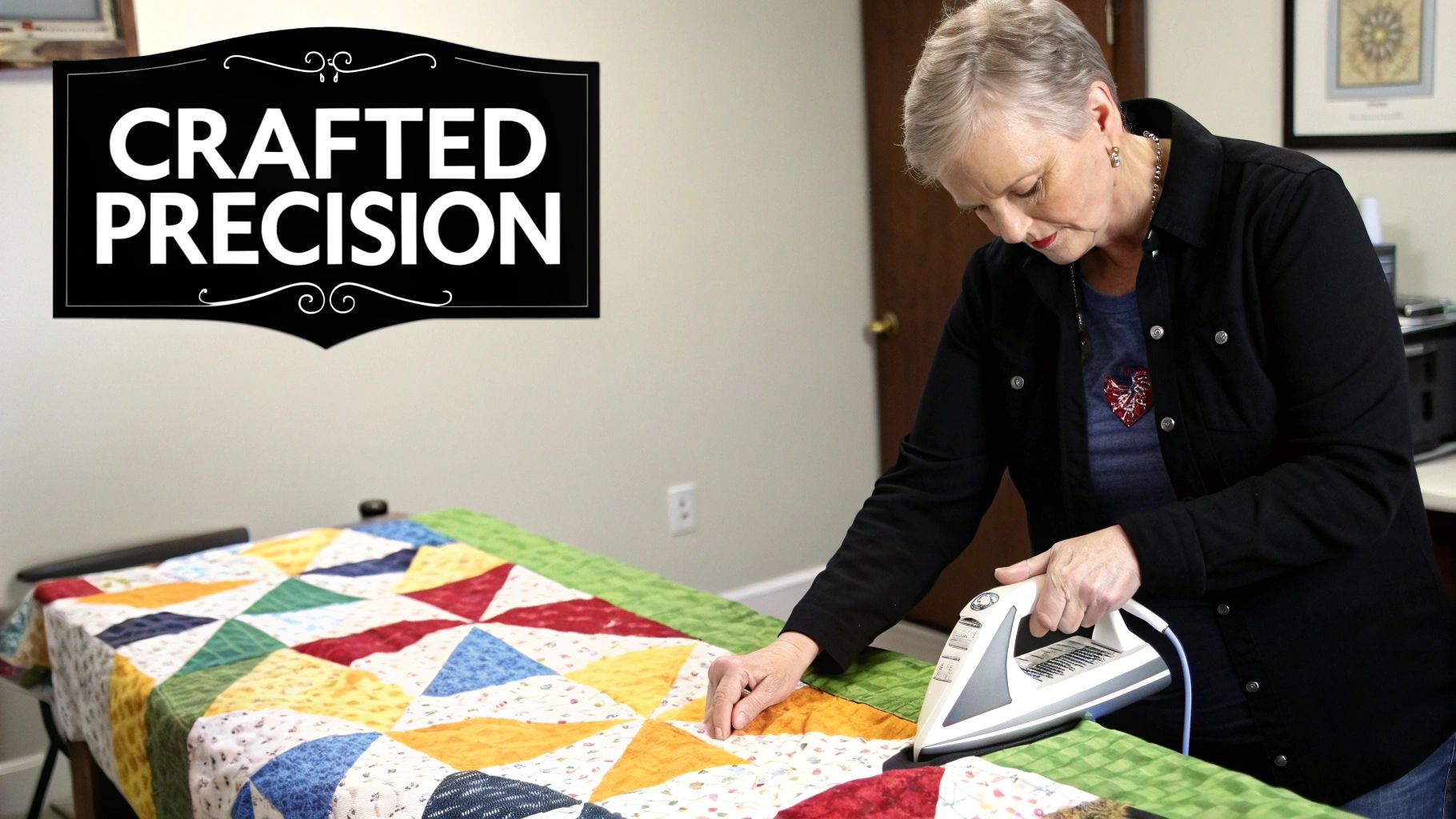
From pre-shrinking your fabric to setting seams without stretching them out of shape, consistent heat and controlled steam affect every single stage of your project. The right iron guarantees your piecing stays accurate. Quilting just presents unique challenges that your average iron isn't equipped to handle well.
Think about it: you're navigating tiny fabric pieces, trying to protect delicate bias edges, and getting those points to match up perfectly. This calls for specific features. A good quilting iron often has a precision tip for sneaking into tight corners and a soleplate designed to distribute heat evenly across the entire surface. This design prevents frustrating hot spots that can scorch your beautiful cotton fabrics.
A great iron doesn't just flatten fabric; it molds it. It sets each seam with intention, ensuring that every block lays perfectly flat and contributes to the overall accuracy and beauty of the finished quilt.
It's no surprise that as quilting has grown in popularity, the tools of the trade have gotten better and better. The global market for quilting tools, including specialized irons, was valued at around $850 million in 2023 and is projected to keep growing. This trend, which you can read more about in market reports from Dataintelo, shows a wider recognition that quality tools lead to quality results.
Ultimately, investing in one of the best irons for quilters isn’t a simple upgrade. It’s a foundational step toward creating cleaner, flatter, and more accurate quilts. It turns pressing from a chore into a vital part of the creative process, giving you far more control and a much better outcome.
Trying to choose the right iron can feel like drowning in a sea of marketing jargon. Every box screams about a dozen different features, but what actually helps you get those perfectly flat seams and crisp blocks? We need to cut through that noise and zero in on what makes an iron a quilter’s best friend.
It all comes down to how an iron's design translates to better results on your pressing mat.
The heart of any good iron is its soleplate. While you'll find a few different materials out there, the real debate for quilters is between ceramic and stainless steel. Stainless steel gets hot fast and is tough as nails, surviving accidental drops or bumps. Ceramic, on the other hand, is the master of even heat distribution, which minimizes the risk of scorching your precious fabrics. Honestly, you can’t go wrong with either, but knowing the subtle differences might sway you one way or the other based on your own pressing habits.
For quilters, high, consistent heat isn't just a nice-to-have; it's a must. Cotton, the fabric we all know and love, needs a serious dose of heat to get seams to behave. I always tell people to look for an iron with at least 1500 to 1800 watts. That wattage ensures it not only reaches temperature quickly but, more importantly, stays hot between presses.
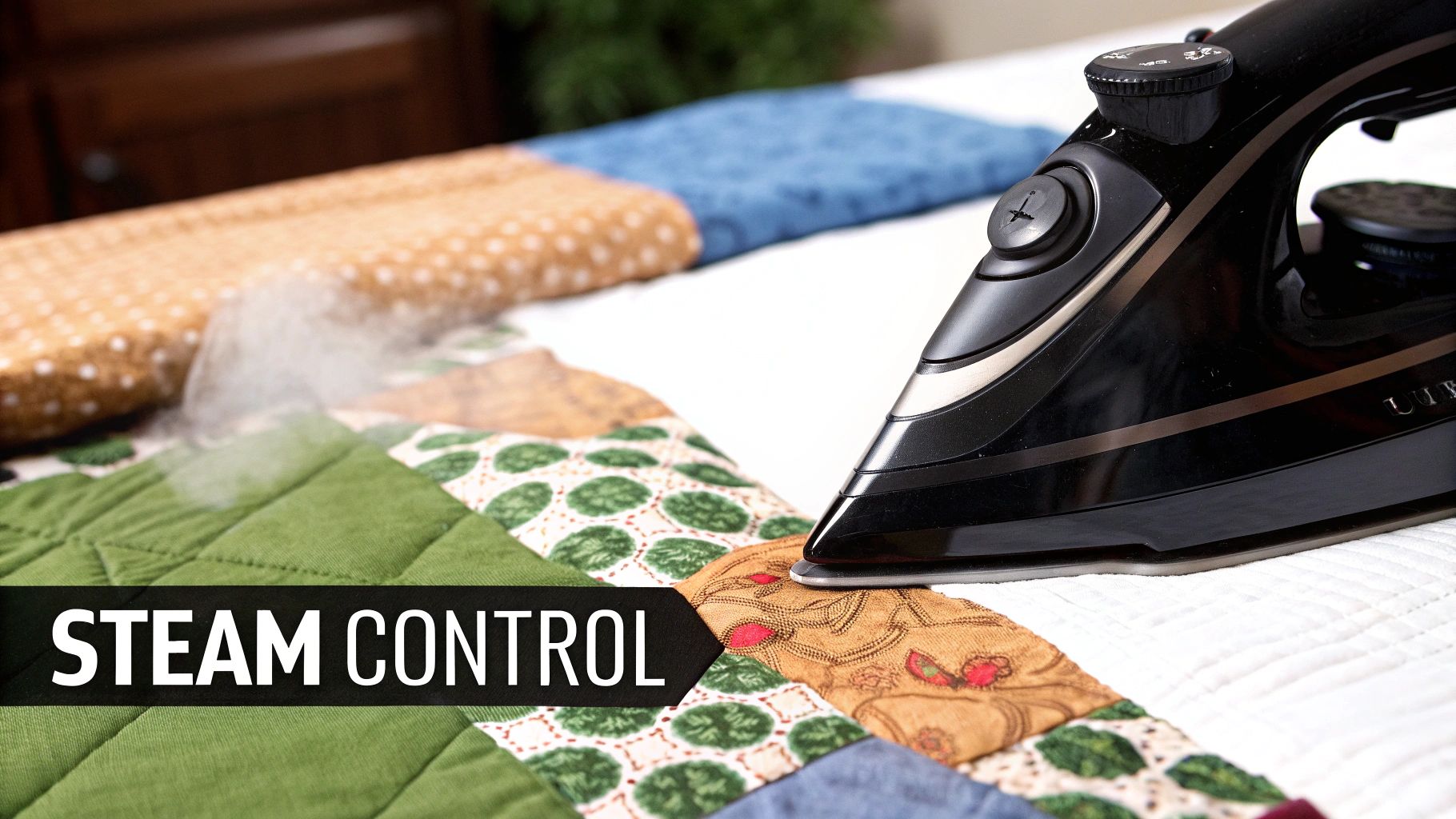
Steam is your other secret weapon, but it’s not about sheer volume. The best quilting irons have dozens of tiny micro-steam vents dotted across the soleplate. This setup creates a fine, powerful burst of steam that penetrates fabric fibers without drenching them—a critical detail for preventing warping and stretching.
The whole point of steam is to relax the fabric just enough to press it flat, not to soak it. A block that’s too wet can easily get pulled out of shape, and that’s a quick way to ruin the accuracy of your entire quilt top.
This need for high-performance tools is a huge part of the quilting scene. North America is a quilting giant, and it's expected to make up a 39.02% share of the worldwide quilt market by 2025. With the United States accounting for over 71% of that, it's no wonder there's such a demand for specialized gear. If you're a data nerd like me, you can dig into more stats in this comprehensive report.
The way an iron feels in your hand can make a world of difference, especially when you're hours deep into a project. Pay attention to the practical stuff:
Finally, let's talk about the auto shut-off feature—a classic love-hate relationship for quilters. It’s an amazing safety net, for sure. But it can be incredibly annoying when your iron decides to nap in the middle of a chain-piecing marathon. The absolute best irons solve this problem with an override function, giving you peace of mind without killing your workflow.
Picking the right iron is a surprisingly personal decision for a quilter. It’s a tool that directly shapes your work, and what works wonders for one person might feel clunky to another. To get past the marketing fluff, we need to look at how these irons actually perform when you’re pressing a tricky star point versus a long, simple seam.
Let's put a couple of the most talked-about models head-to-head. The goal here isn't to crown one "winner," but to figure out which iron is the absolute best fit for your specific quilting style.
Quilters know the Oliso TG1600. Its claim to fame is the iTouch auto-lift system—a clever feature that pops the iron up on little "scorchguards" the second you take your hand off the handle.
If you spend hours chain-piecing, this is a game-changer for your wrist. You can leave the iron face-down and ready, cutting out that constant up-and-down motion. It's a small change that makes a huge difference in fatigue during a long quilting session.
Beyond that signature feature, the TG1600 has a fantastic pointed tip, perfect for nudging open those tiny seams in flying geese or foundation paper piecing. And with 1800 watts of power, it gets hot fast and stays there.
The Oliso TG1600 is all about improving your workflow. By eliminating wasted movement, it helps you press seams quicker and with less strain—a massive advantage for anyone who quilts in batches.
The one catch? You have to unlearn years of muscle memory. I can't tell you how many times I've seen new Oliso users instinctively tilt the iron up out of habit. It takes a little getting used to, and its electronic nature might be a turn-off for quilters who prefer simpler tools.
The Reliable Velocity 270IR takes a completely different path, focusing on brute-force steam and a rock-solid build. This iron has a satisfying heft to it; its weight does a lot of the pressing work for you.
Its real magic is the internal steam generator. Most irons just drip water onto a hot plate, which is why they spit and leak. The Velocity actually pre-heats the water into pure steam before it hits the soleplate. The result is a powerful, continuous cloud of steam with almost zero sputtering.
This makes the Velocity 270IR unbeatable for a couple of key quilting tasks:
This visual breakdown shows how some popular models compare on the essentials.
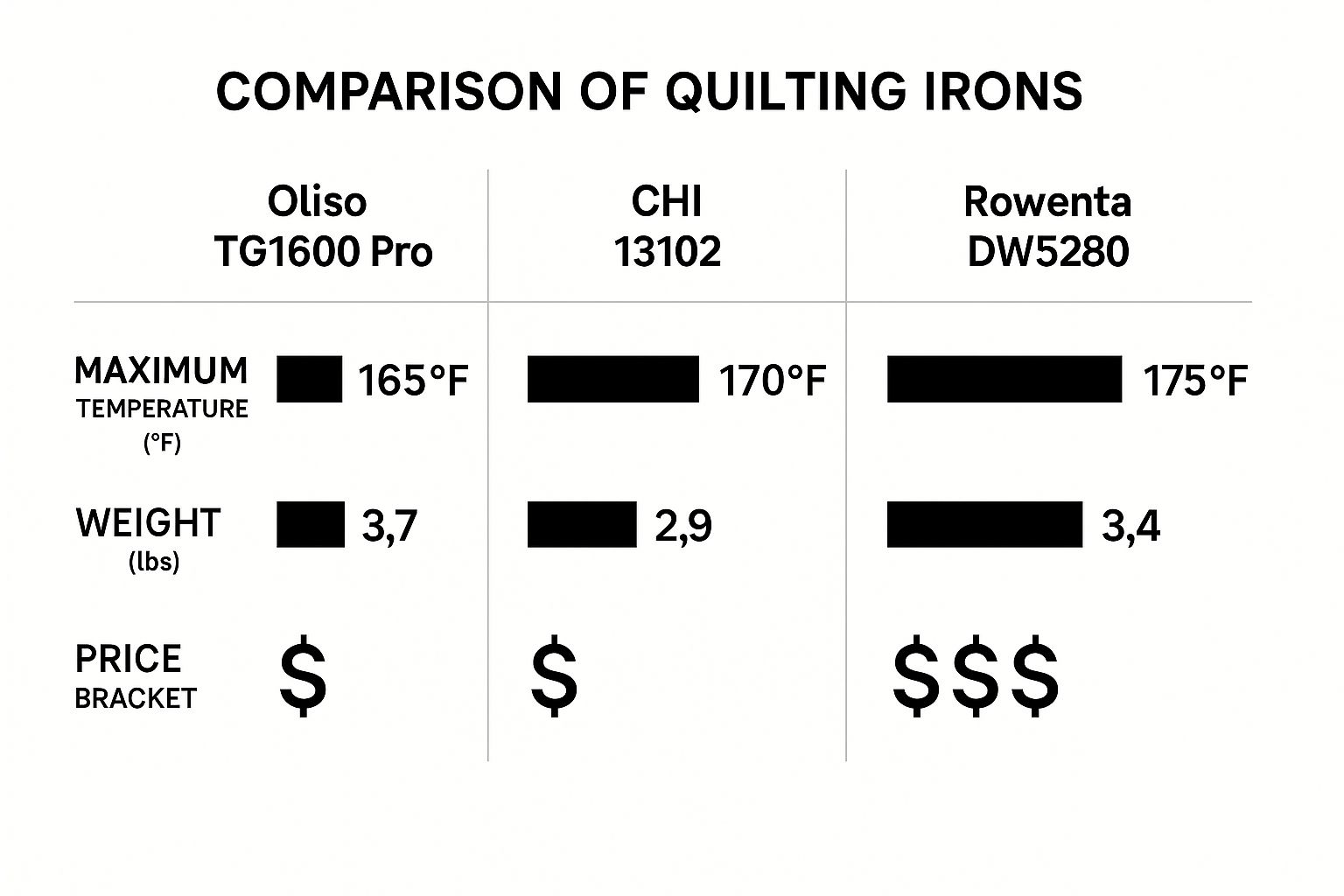
As you can see, there's a clear trade-off. More expensive irons generally bring more weight and higher heat to the table, which is exactly what you need for more demanding pressing jobs.
To make sense of the key differences, it helps to see the specs side-by-side. This table breaks down what really matters for quilters when comparing these popular models.
| Iron Model | Soleplate Type | Steam Output (g/min) | Key Feature for Quilters | Auto Shut-off |
|---|---|---|---|---|
| Oliso Pro TG1600 | Chromium Finish | ~30-35 g/min | iTouch Auto-Lift System | Yes, 30 minutes |
| Reliable Velocity 270IR | Anodized Aluminum | ~40-45 g/min | Internal Steam Generator (No Spitting) | Yes, 8 minutes |
| Panasonic NI-WL600 | Ceramic (Cordless) | ~12-15 g/min | Cordless Design with 360° Ironing | Yes, 10 minutes |
| Rowenta Pro Master | Stainless Steel/Microsteam | ~40 g/min | 400-Hole Soleplate for Even Steam | Yes, 8 minutes |
This comparison highlights the core strengths of each iron. The Oliso prioritizes ergonomics, the Reliable focuses on steam quality, the Panasonic offers freedom of movement, and the Rowenta excels at steam distribution.
The right choice comes down to your personal quilting style and what frustrates you the most about your current iron.
Go with the Oliso Pro TG1600 if:
Go with the Reliable Velocity 270IR if:
For those who need the absolute pinnacle of steam performance, there's another class of iron to consider: a gravity-feed iron. Systems from brands like Silver Star use a separate water bottle that hangs above your ironing board, feeding a constant supply of dry steam. They are heavy and require a dedicated setup, but for sheer, unrelenting pressing power, nothing else comes close.
In the end, the best quilting iron is the one that gets out of your way and lets you create. Whether it’s the smart lifting of an Oliso or the pure steam force of a Reliable, the right tool turns pressing from a chore into a satisfying step toward a finished quilt.
Walk into any quilting guild meeting and bring up the topic of steam versus dry ironing. You'll probably spark a lively debate with as many opinions as there are quilters in the room. The truth is, there's no single "right" answer. The best technique really boils down to what you're trying to accomplish at that moment. Learning when to reach for steam and when to stick with a dry iron is one of those skills that can take your piecing from good to truly exceptional.
This conversation is more relevant now than ever. Quilting has exploded into a massive global community, with the market valued at an incredible USD 231.26 billion back in 2023 and still growing. That passion fuels the demand for better tools and techniques. If you're curious, you can explore more quilt market insights and see just how big our world has become.
Steam is a powerhouse for relaxing fabric fibers, which makes it the perfect tool for a few specific jobs. I always use steam when I’m prepping my yardage before the first cut. A good shot of steam is fantastic for getting out those deep-set creases from the bolt, making sure your fabric is completely flat and true to size before you lay down your ruler.
It’s also my go-to for the final press of a finished quilt block or the entire quilt top. That combination of moisture and heat really helps meld the seam threads into the fabric. This creates a beautifully flat, durable finish that’s perfect for the final quilting stage.
Think of steam as your tool for persuasion. It's brilliant for pre-washing and giving a quilt top its final, flawless finish. But when you're in the middle of piecing, that same persuasive power can introduce instability—and instability is the enemy of precision.
When you’re actually piecing your blocks together, dry heat is almost always the way to go. This is non-negotiable when you’re working with bias edges—any part of the fabric that isn’t on the straight grain. Hitting those stretchy edges with steam is asking for trouble; it can easily distort your perfectly cut pieces and throw off your whole block.
Here are a few scenarios where a dry iron is a must:
Ultimately, the best quilters have mastered both techniques. The ideal iron for quilting isn't just one that gets hot; it's one that can deliver a powerful, controlled burst of steam when you need it and then switch to consistent, high dry heat when you don't. Knowing exactly when to flip that switch is the real secret to achieving a flat, flawless quilt top every single time.
https://www.youtube.com/embed/GI4Q22GdcOE
There's no single "best" iron for every quilter out there. The perfect iron for you is the one that fits your specific process like a glove. Think about it: the ideal tool for someone chain-piecing for hours on end is going to be completely different from what an appliqué artist needs.
The key is to honestly look at how you spend your time at the pressing mat. Once you identify your primary quilting style, you can zero in on the features that will genuinely make your work easier, more precise, and frankly, more enjoyable. This isn't about getting the iron with the longest list of features; it's about getting the one with the right features for you.
If you live for foundation paper piecing (FPP) and chase those perfectly sharp points, your iron needs to be nimble and exact. You're constantly flipping fabric, pressing tiny seams, and maneuvering into tight corners. A clunky, heavy iron just gets in the way.
Your ideal iron must have two key things:
A full-sized iron can feel like you're trying to do surgery with a sledgehammer. For this kind of detailed work, a smaller, detail-focused iron is a much smarter tool.
When you're paper piecing, control is everything. Your iron should feel like a precision instrument, allowing you to set each tiny seam perfectly without disturbing the rest of the block.
Are you the quilter who dedicates an afternoon to pressing hundreds of half-square triangles at once? If you’re a batch processor, your pressing station is an assembly line, and your main goals are endurance and efficiency. It’s all about getting into a rhythm and staying there.
You need an iron that’s a true workhorse. Forget the bells and whistles and focus on features that cut down on interruptions and keep the power coming.
Look for these workhorse features:
When you're wrangling a massive quilt back or working around a longarm frame, the last thing you want is to fight with a power cord. A dangling cord isn't just annoying; it’s a legitimate hazard that can snag on your frame, drag across your quilt top, or even pull the iron off your table.
This is where a cordless iron truly proves its worth. While they generally can't match the sustained heat and steam output of a corded model, their incredible portability is a huge win for large-scale work.
You can grab it, press a long seam on a quilt back right on the floor, and put it back on its base without ever wrestling with a cord. For quilters who prioritize maneuverability over raw power, a cordless model is often the best choice.
It's one thing to compare specs on a screen, but another to feel confident about which iron is right for your sewing room. You've probably still got a few questions buzzing around. That's completely normal—choosing the right tool involves getting into the nitty-gritty details.
Here, I'll tackle the most common questions quilters ask. Think of this as a conversation we'd have in the shop. My goal is to clear up any lingering doubts so you can invest in an iron that truly supports your passion.
Honestly, you can use a regular household iron, but a dedicated quilting iron makes a world of difference in the final quality of your quilt top. The biggest advantage is heat. Quilting irons are built to get hotter and, more importantly, stay hotter, which is non-negotiable for getting those perfectly flat, crisp seams on cotton fabrics.
They’re also designed with precision in mind. You’ll notice they often have more steam holes, but they're smaller, delivering powerful, targeted bursts of steam right where you need them. The tip is usually sharper for getting into tight corners, and the iron itself often has more heft. That extra weight does a lot of the work for you, pressing seams open with less elbow grease. For anyone serious about quilting, it’s an investment you won't regret.
When you're looking at specs, aim for an iron in the 1500 to 1800-watt range. It’s not just about how fast it heats up, but how well it recovers that heat. Higher wattage is crucial for maintaining a consistent temperature, especially when you’re in the zone.
Picture this: you're chain-piecing a huge batch of blocks. A lower-wattage iron will cool down with each press, giving you inconsistent results and sad, floppy seams. A powerful iron, on the other hand, bounces back to its set temperature almost instantly. Every single seam gets the same blast of heat, which is the secret to a beautifully flat and accurate quilt top.
Think of an iron’s wattage as its stamina. An 1800-watt iron is like a marathon runner—it has the power to keep going at peak performance, ensuring your workflow never misses a beat.
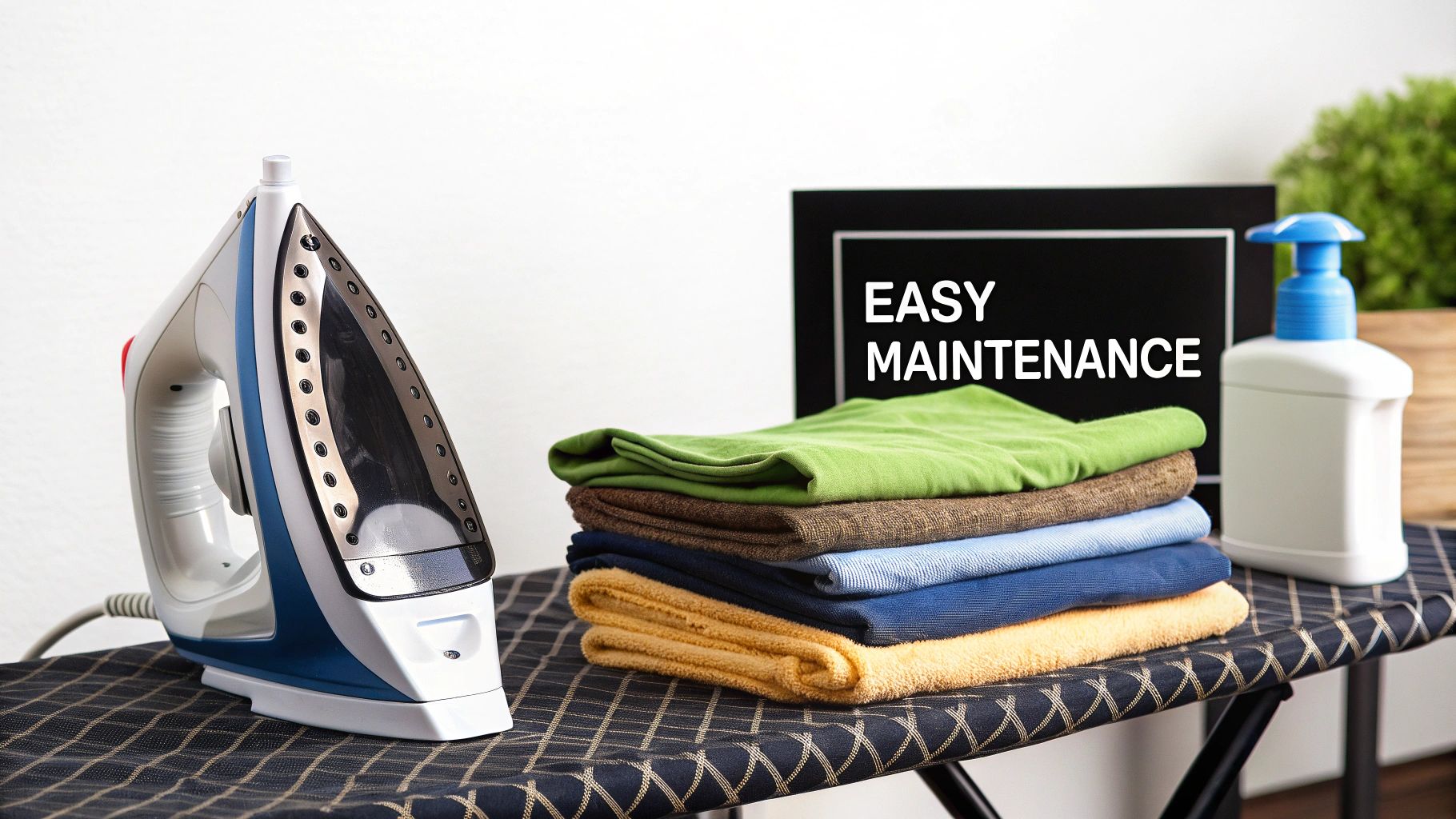
A clean soleplate is a happy soleplate. It’s absolutely key for gliding smoothly across your fabric and making sure you don't transfer any gunk onto your pristine quilt blocks. For light buildup from starch or fusible web, you can often just wipe a warm (not scorching hot!) iron with a damp cloth or even a clean dryer sheet. It’s a surprisingly effective little trick.
For the more stubborn, baked-on messes, you’ll need to bring in the big guns: a commercial hot iron cleaner. You’ll apply it to a scrap piece of fabric and run the hot iron over it until all that residue lifts off the soleplate and onto the cloth. Just be sure to follow the directions on the package and never, ever use anything abrasive like steel wool. It will permanently scratch your soleplate and ruin its smooth glide. A little maintenance goes a long way.
At High Country Quilts, we know that the right tools can completely change your quilting experience. We've hand-picked a selection of high-performance irons and other must-have supplies to help you do your best work. Visit us online or in our Colorado Springs store today!
At High Country Quilts we care deeply about community. With our experiences in retail, we know that a store is not only a place to shop but also a place for the community to gather and share. During this busy...

Hi! We’re Adam and Renee Wheaton, the new owners of High Country Quilts! For more than 40 years, we’ve owned and operated vacuum and sewing businesses. Following in Renee’s father’s footsteps after he retired from All Discount Vacuum and Sewing in Colorado...


Leave a comment