
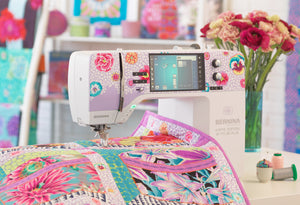

We Love Our Quilting Community
At High Country Quilts we care deeply about community. With our experiences in retail, we know that a store is not only a place to shop but also a place for the community to gather and share. During this busy...


You're standing at the cutting table with a finished quilt top in one hand and a roll of standard-width fabric in the other, doing the same mental math quilters have done for years. The back is the part that suddenly gets complicated, seams start multiplying, and a project that felt nearly done turns back into a layout puzzle. 108 wide quilt backing changes that experience fast, because the backing can often be cut as one clean span instead of pieced from multiple strips.
That simple width shift is why so many quilters keep extra-wide backing on the shortlist for bed quilts. It reduces seam work, helps the back lie flatter, and gives you a much more straightforward path from quilt top to finished project. The trick is buying the right amount, handling the fabric correctly, and knowing when the convenience is worth it.
The first time you lay a queen-size quilt top beside a bolt of 108-inch-wide backing, the difference is immediate. Standard quilting cotton usually runs 42 to 45 inches wide, so a large back often becomes a construction project of its own. A 108-inch wide back, about 274 cm, can cover the same space with far fewer seams, which is why it's become a standard option for larger quilts and especially bed-size projects like queen and king sizes. Source data on width and coverage

A queen quilt measuring 90 × 108 inches generally needs about 3 to 3.5 yards of 108-inch-wide backing, compared with roughly 8 yards of 44-inch fabric for a pieced back. That's not a small convenience, it's a different workflow, because the wider cloth can cover the back with fewer joins and less cutting complexity. Yardage comparison and coverage math
Practical rule: If a quilt back can be one piece, the finishing stage gets calmer. Less piecing means fewer opportunities for mismatched seams, and beginners usually feel that difference right away.
A wide back also helps experienced quilters who care about the look of the finished reverse side. A cleaner back doesn't just save time, it can make the quilting lines read more clearly and reduce the visual busyness that comes from multiple panels. For anyone who likes to finish projects without wrestling with large seam intersections, that matters more than the ticket price per yard.
For environmental portrait framing and workshop-style product photos, SendPhoto environmental portrait tips is a useful reference on how to keep large subjects looking natural in a real studio setting.
The money question usually comes down to coverage, not just sticker price. One yard of 108-inch fabric gives you 3,888 square inches of material, while one yard of 44/45-inch fabric gives you 1,584 square inches. That is why the wider fabric can look pricier per yard and still cost less for the backing you need. Square-inch math and project comparison
The savings show up in whole-project comparisons too. One published example showed a 2.25-yard 108-inch backing costing $40.47 at $17.99 per yard, while the equivalent pieced backing from 44/45-inch fabric cost $66.13, a difference of $25.66. Another example showed a queen back needing only 2 yards of 108-inch fabric versus a pieced option that cost about $10 less in wide-back form because no seam construction was required. Backing cost comparison examples
The gap gets larger on bigger bed quilts. A king quilt may need about 4 yards of 108-inch backing, while standard-width fabric can require around 9.5 yards. Another comparison puts a twin-size quilt at about 6 yards of 44-inch fabric, or $72 at $12 per yard, versus about 2 yards of 108-inch backing at roughly $40 to $50, which saves about $22 to $32. Twin and queen/king cost comparison
| Quilt Size | Standard Fabric Yards | Standard Fabric Cost | 108-Wide Yards | 108-Wide Cost | Savings |
|---|---|---|---|---|---|
| Twin | 6 | $72 | 2 | $40 to $50 | $22 to $32 |
| Queen | Roughly 8 | Not stated | 3 to 3.5 | Not stated | Less yardage and fewer seams |
| King | About 9.5 | Not stated | About 4 | Not stated | Less yardage and fewer seams |
Wide backing also saves work at the machine. Fewer seams mean less pressing, less matching, and less chance of wasting fabric while trimming oversized pieced panels. If you are buying for a large quilt and want a cleaner finish with less handling, the per-yard price is only part of the story.

A good cut plan starts with the finished quilt top, not the bolt. Measure the top after borders are on, then add quilting ease so the backing can load cleanly, stay square, and survive trimming without leaving you short. With 108 wide quilt backing, the goal is to keep the 108-inch dimension running across the quilt width so you use the cloth the way it was made to be used. One retailer recommends adding about 6 inches total for quilting ease, and if you are prewashing, allowing an extra 1/8 to 1/4 yard for shrinkage. In their worked example, a 60 × 72 inch top becomes a backing cut of at least 73 × 85 inches, which works out to about 1.89 yards and rounds up to 2 yards for a 72 × 108 inch piece. Worked example and yardage method
Measure the quilt top's final width and length after borders, then add enough room on all sides for loading, squaring, and quilting. After that, check whether the backing width can cover the quilt width without forcing a seam down the middle. A broader rule from another guide says to add about 8 inches total to the quilt dimension being backed, then divide by 36 to estimate yardage. Yardage rule and example
The part that trips up beginners is treating 108-inch fabric like ordinary yardage. It does not work that way. The width is already built in, so you are calculating the needed length for the long edge, not using the usual widths-of-fabric formula. A 60 × 72 inch top, for example, becomes a 73-inch backing width requirement in one worked model, which is why the answer is about 2 yards, not a standard-width piecing estimate.
Good fit benchmark: Industry guidance describes a good fit for 108-inch wideback as roughly 4 to 6 inches of overhang on all sides, with queen-size tops fitting well and king-size tops being tighter unless the backing is wider, such as 120 inches. Width-fit guidance
A second guide gives a useful shopping shortcut. It says many standard quilts need roughly 1 to 3 yards of 108-inch fabric depending on size, with twin quilts often around 2 1/2 yards and queen quilts around 3 to 3 1/4 yards. That range helps when you are standing in the shop and need a quick estimate, but your own quilt top still deserves a fresh measurement because borders, quilting style, and print direction all change the amount you need.

A one-piece back is a luxury only when the quilt fits the cloth. For many throw, twin, and queen projects, 108-inch backing covers the width cleanly and avoids the long center seam that standard-width fabric usually creates. For larger quilts, the fit gets tighter, and a pieced backing or a wider backing option may give you more room for loading, trimming, and a little shrinkage after quilting.
A queen quilt is often the sweet spot for 108-inch fabric. A king can still work, but the margin gets narrower, so you need to watch longarm allowance, print direction, and any future shrinkage. As noted earlier, king tops are tighter unless the backing is 120 inches wide, which gives you a practical cutoff when you are planning a larger bed quilt.
If the quilt top exceeds what one width can cover comfortably, piecing can still be the right answer. The question is whether the project benefits more from a clean one-panel back or from the flexibility of joining widths. I've seen quilters choose seams on purpose when the print needed to run in a certain direction, or when the quilt was too large to risk a short edge after quilting and squaring.
A shop counter rule that helps is to reserve 108-inch wideback for projects where the quilt length is near or below 100 inches and where minimizing seams matters most. That is not a hard law, but it gives you a workable line when you are deciding between convenience and extra handling. If the back will be prewashed, heavily quilted, or loaded onto a longarm, oversizing the cut gives you more insurance against coming up short.
For a practical comparison, High Country Quilts carries quilting fabrics and can help you weigh wideback choices against standard backing when you are matching the quilt to the machine setup. That side-by-side check matters more than chasing a single “best” answer, because the right backing depends on the quilt's size, print direction, and how it will be quilted.
Wide backing saves time at the cutting table, but it still needs a careful start. Fabrics can come off the bolt with folds, slight twist, or edges that are not running perfectly true, and that is common enough with wide goods to plan for. Unroll the cloth fully before you cut, then check that both edges are straight and the width is behaving the way you expect.
Prewashing makes sense when the fabric is dark, heavily saturated, or likely to bleed. It also helps when the cloth feels stiff from sizing or when you want any shrinkage to happen before the backing meets the quilt top. After washing, press the fabric so the folds relax and the width lies flat. A twisted back can create trouble once it is loaded for quilting. Prewashing and handling advice
If you are piecing more than one width because the quilt needs it, the grain has to stay in line. Align warp to warp and weft to weft so the joined backing behaves predictably during longarm quilting. That detail is easy to miss on a busy cutting day, but a crooked grain can show up later as puckering or a seam that fights the rest of the quilt.
A straight start saves frustration later.
The biggest problem with wide backing usually is not the fabric itself. It is the assumption that one wide cut removes the need to measure carefully.
For longer quilts, the backing works better when you treat it like a finished panel instead of ordinary yardage. Once it is pressed and squared, it handles more predictably on the frame or at the machine. That is where the convenience of 108 wide quilt backing starts to pay off in the sewing room.
The most common mistake is buying by habit instead of by measurement. Quilters who are used to 44-inch fabric sometimes forget that the backing length still has to cover the quilt's long edge, even when the width problem is solved. That is how people end up short, especially if they do not leave room for quilting ease or for shrinkage after prewashing.
Fabric twist causes another set of problems. Wide backings spend a lot of time folded on the bolt, and the edges can drift out of square before you ever get to the machine. If the grain looks off, correct it before cutting. A crooked starting edge tends to show up later as puckering or a backing that does not lie flat once the quilt is basted and stitched.
If you are still unsure, a shop with quilting machines and support can help you sort out the prep before the fabric gets cut. High Country Quilts works in that practical space, where the answer is less about theory and more about making sure the backing fits the quilt and the machine.
If you want help choosing the right 108 wide quilt backing for your next quilt, visit High Country Quilts for fabric, tools, and guidance that matches the size of your project. Bring your quilt measurements, and you can leave with a backing plan that is cut right the first time.
At High Country Quilts we care deeply about community. With our experiences in retail, we know that a store is not only a place to shop but also a place for the community to gather and share. During this busy...

Hi! We’re Adam and Renee Wheaton, the new owners of High Country Quilts! For more than 40 years, we’ve owned and operated vacuum and sewing businesses. Following in Renee’s father’s footsteps after he retired from All Discount Vacuum and Sewing in Colorado...


Leave a comment