


Free Fabric All Year: Our 2027 Fabric Punch Card
November 2–25 only: buy a $200 gift card in either store and get a free yard of fabric every month of 2027.

Last Updated: November 8, 2026
Quick Summary
To find how much quilt batting you need, measure the finished quilt top, then add 6 to 8 inches to both the width and the length. Buy a package at least that large in both directions, rounding up to the next standard size if needed.
Knowing how much batting do I need for a quilt starts with one number: the size of your finished quilt top. Measure it first, because every batting calculation builds on those dimensions. Many quilters buy batting before they measure, and that is a common reason for a short roll. Measure the width and length in the center of the top, then check the edges, since seams can pull a top slightly out of square.
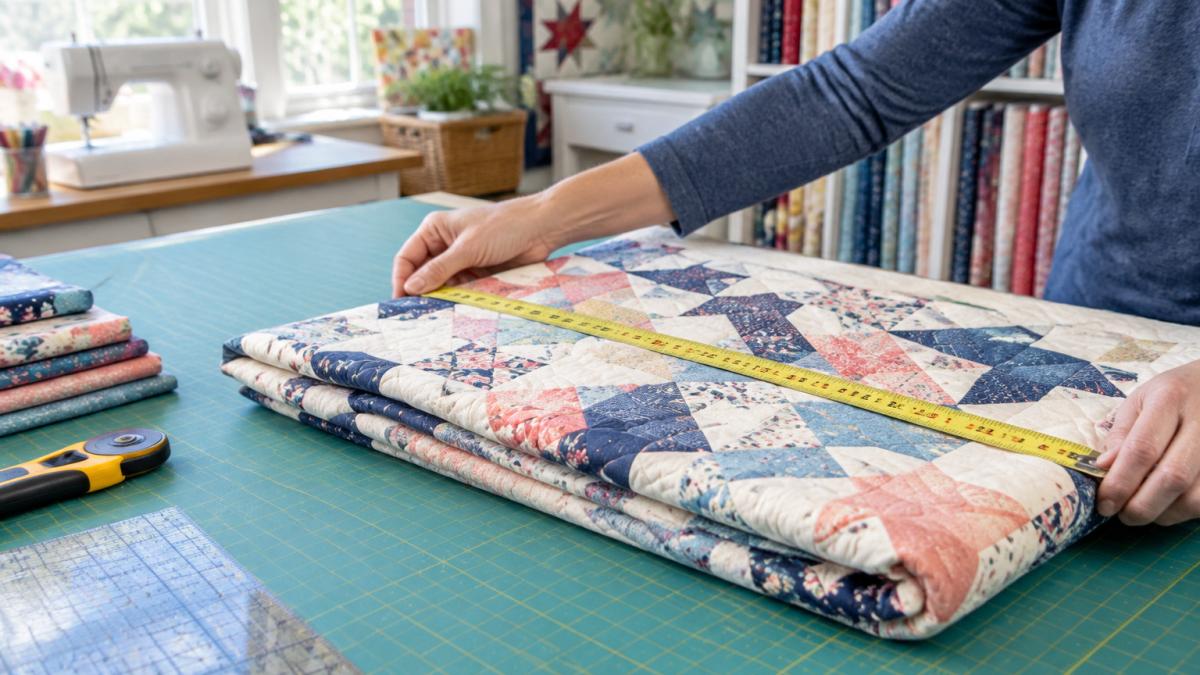
!A quilter's hands holding a metal measuring tape across a folded quilt top on a cutting table in a bright sewing room
Here is a simple way to measure:
A quilters tape measure works well for this. The Quilters Tape Measure 3 4inx120in is wide enough to stay flat across a throw-size top.
Batting needs to be larger than the quilt top so you have room to hold the layers together during quilting. Most quilters add about 3 to 4 inches on each side, which works out to 6 to 8 inches in total for each dimension.
The formula is simple:
Use the higher number if you plan to machine quilt with a lot of stitching, since the layers can shift more. Add a bit more if you will load the quilt on a long-arm frame.
Say your quilt top measures 60 inches wide and 72 inches long.
You need batting at least 68 x 80 inches. Batting packages are sold in set sizes, so you would choose the next size up that fits those numbers.
Quilt batting comes in pre-cut packages, and most quilters buy by package rather than by the yard. The package label gives the batting's finished width and length, not the quilt size it fits. Check those package dimensions against your calculated batting size before you buy, and always round up to the next package that is at least as large as your number in both directions.
Common package sizes include:
Those are typical package dimensions, but brands vary, so read the label rather than assuming a name. A package labeled "queen" is not automatically large enough for a queen-size quilt top once you add overage.
Say your quilt top is 60 x 72 inches and you add 8 inches to each dimension, giving a batting size of 68 x 80 inches. A throw package at 60 x 72 inches is too small in both directions. A twin package at 72 x 90 inches fits the width and length with room to spare, so twin is the correct buy even though the quilt is throw-size. The rule is simple: compare your calculated width and length to the package's width and length separately, and pick the smallest package that meets or exceeds both numbers. Do not average or split the difference.
Watch out: a package can be wide enough but too short, or long enough but too narrow. Check both dimensions on the label before you commit, because a package that fails one dimension will force you to piece the batting. When a package misses either measurement, piecing the batting is one option, while Artsi2 can spark ideas for a no-sew quilt that avoids batting altogether.
If you want to compare batting types before choosing a size, read What Is the Best Batting for a Quilt? for a closer look at loft and fiber.
For a small lap or baby quilt, the Single Side Fusible Batting 45 X 36 Package 2 is a compact option to consider. Measure your top first, though, because a 45 x 36 package leaves little overage once you add the 6 to 8 inches the formula calls for.
The standard package sizes below help you match your calculated batting size to a package that is large enough in both directions.
| Package | Approximate size | Typical use |
|---|---|---|
| Crib | 45 x 60 inches | Baby quilts |
| Throw | 60 x 72 inches | Throw-size quilts |
| Twin | 72 x 90 inches | Twin-size or throw with overage |
| Full | 81 x 96 inches | Full-size quilts |
| Queen | 90 x 108 inches | Queen-size quilts |
| King | 120 x 120 inches | King-size quilts |
A finished queen-size quilt top is often about 90 x 108 inches, though designs vary. Add 6 to 8 inches to each side, and you get a batting size of roughly 96 x 116 inches.
Because standard queen packages are 90 x 108 inches, many quilters find the package is too small once they add the overage. In that case, a larger package is the safer choice. The Pellon White Cotton Batting With Scrim 90 x 108 Queen Size Package is priced at $35.99, and the King Size Package is priced at $44.99.


The overage you need depends on how the quilt will be quilted, because each method pulls, stretches, and holds the layers differently. The ranges below are common starting points, not universal rules.
Backing needs the same planning, and in practice backing is often cut slightly larger than batting so it can be loaded and clamped. Calculate backing size at the same time as the batting rather than after, because the two are loaded together on a long-arm frame.
If a long-armer will quilt your project, ask for their written requirements before you buy or cut anything. Providers commonly specify a minimum overage on all four sides, whether they want the backing and batting squared, and whether they accept pieced backing. Requirements vary by provider and by frame, so a range from an article is not a substitute for the quilter's own instructions. Get the answer in writing, then add the overage to your measured quilt top and buy to that number.
Cutting batting to the exact calculated size before confirming the quilter's margin can leave too little fabric to load. Measure, confirm, then cut.
Check any fabric requirements in the Updated No Math Quilt Charts & Formulas guide, which includes formulas for backing and binding.

Batting size is the finished width and length of a package. Batting yardage is how it is sold off the bolt, usually in a set width. Do not mix the two. A 90-inch-wide roll covers a wide quilt in one piece, while narrower batting may need piecing.
If your batting is narrower than the quilt top plus overage, you have two options:
Piecing works, but a seam can show through lighter fabric or cause a ridge. A wider package usually gives a smoother result.
Batting type also affects the final size. Cotton batting can shrink 3 to 5 percent after washing, while polyester batting changes less. Loft, which is the thickness of the batting, changes how the quilt drapes, so choose a loft that matches your project.
A quilt batting calculator can speed up the math, but it is still worth checking by hand. Enter your finished top dimensions, add your overage, and compare the result with the package sizes above.
Keep the Updated No Math Quilt Charts & Formulas guide nearby while you plan. It gives you quick formulas for backing and binding, so you can check the whole project in one place.
Once you have your final number, visit High Country Quilts to see batting in person and ask our staff about the right size for your project. Use the Aurifil Real Thread Chart to match thread colors to your fabrics before you cut.
Most quilters add 3 to 4 inches of batting beyond each edge of the quilt top, which totals 6 to 8 inches in each direction. Hand quilters and those using a domestic machine with a small harp often trim the allowance closer to 3 inches per side. Long-arm quilting services typically require more, and many ask for 4 to 6 inches per side, so check with your quilter before you cut. Because batting can shift during basting, the extra inches also protect the edges from being short.
A finished queen-size quilt top is usually about 90 by 108 inches. Adding 3 to 4 inches of overage per side gives a batting size near 96 by 114 inches for domestic quilting. Pellon's 90 by 108 inch queen package is slightly too small once overage is added, so many quilters choose the 120 by 120 inch king package when they plan to long-arm quilt. The 120 by 120 inch package is also a practical size for a queen-size quilt that needs room for extra allowance.
Buy batting at least as large as your quilt top plus the overage your quilting method requires. Measure the top in its finished size, add 6 to 8 inches total to each dimension, and choose the smallest package that covers both numbers. If your top is larger than any single package, you can piece batting together, but the seam must be stitched and pressed flat so it does not show or shift during quilting. Use the Updated No Math Quilt Charts & Formulas guide to check standard bed sizes.
Yes, you can piece batting when a single package is too narrow. Butt the edges together, overlap them slightly, or use a zigzag stitch to join them, then quilt across the seam so it is secured. Many quilters prefer to piece batting along a line of stitching rather than along an open edge. Check that the batting type and loft match across both pieces so the finished quilt does not show a ridge or change in thickness.
November 2–25 only: buy a $200 gift card in either store and get a free yard of fabric every month of 2027.

Serger and BERNINA Mastery classes, longarm training, bag-of-the-month, Kids Sewing Club and a Highlands Ranch retreat. Here's what's on the calendar in November.

Free gifts, included packages and special pricing on the BERNINA 790 ULTRA, 990, Liberty Editions, L 890 serger and Q Series longarms, now through December 31.


Leave a comment