
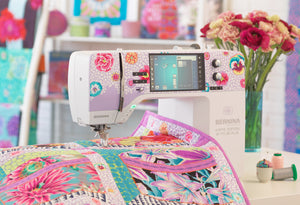

We Love Our Quilting Community
At High Country Quilts we care deeply about community. With our experiences in retail, we know that a store is not only a place to shop but also a place for the community to gather and share. During this busy...


Last Updated: October 12, 2026
Starting a quilt project is simpler than the finished object makes it look. A quilt is a layered textile made of a pieced fabric top, batting in the middle, and a backing fabric, held together with stitching. At High Country Quilts, we have watched beginners in Highlands Ranch, CO turn a stack of fabric squares into something they actually use. The trick is not talent. It is picking a project size and timeline you can finish before your enthusiasm runs out.
A baby quilt or lap quilt is the right first project. Full-size bed quilts take weeks of consistent work, and most first-timers who start there never finish. A lap quilt needs roughly 9 to 12 blocks, which keeps the piecing manageable and lets you practice every skill once.
Think about where the quilt will live, too. A crib quilt for a grandchild or a throw for the couch gives you a concrete finish line.
Give a first lap quilt four to six weekends. Cutting takes one session, piecing two or three, and quilting and binding another two. Quilting is the slow part, so budget more time there than you think you need.
The most common mistake is underestimating binding. It is the last step, but it is also where new quilters stall, so schedule it as its own session rather than tacking it onto the end of a quilting day.
You need five things to start: a sewing machine, a rotary cutter, a cutting mat, an acrylic ruler, and fabric. Everything else is optional until you know you enjoy the process.
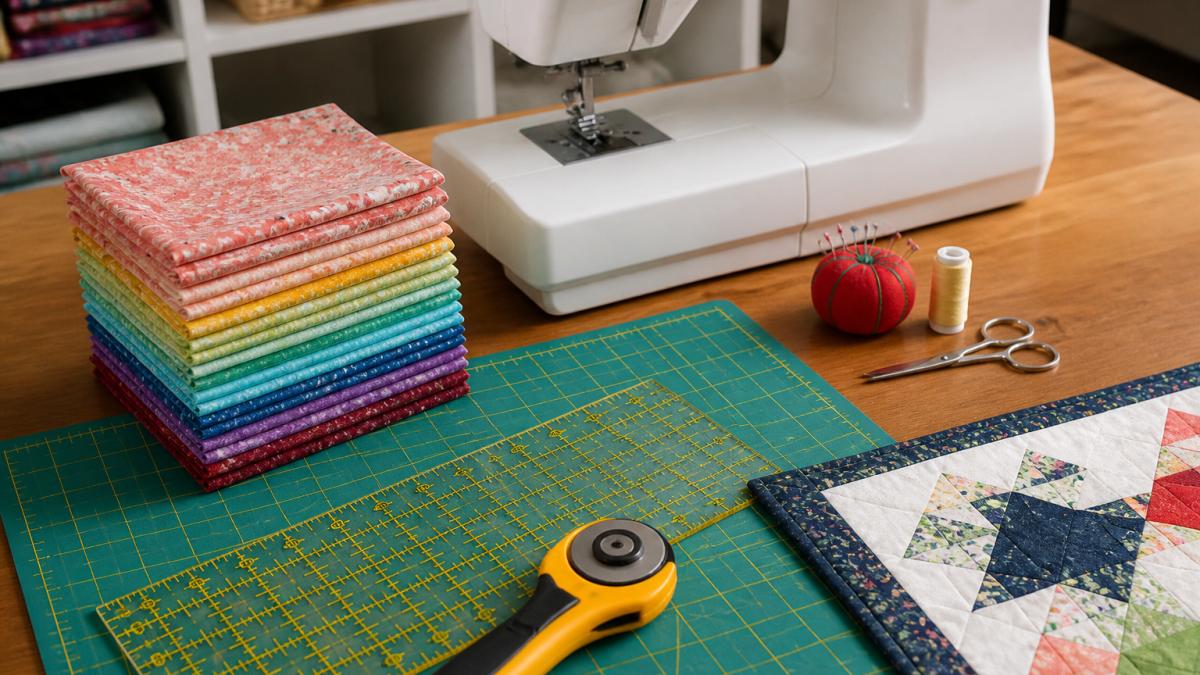
A basic machine with a straight stitch is enough for piecing. You do not need a quilting-specific machine to make your first top, and a walking foot, which feeds layers evenly, can be added later when you are ready to quilt your own layers.
If you are buying your first machine, test it in person. Stitch quality and how the machine feels under your hands matter more than the spec sheet, and a dealer who will service what they sell saves you shipping a machine across the country when something needs adjusting.
A 45-millimetre rotary cutter, a self-healing mat, and a 6 by 24 inch acrylic ruler cover almost every beginner cut. Add a 12-1/2 inch square ruler when you start squaring up blocks; the Creative Grids 12-1/2 inch Square It Up ruler does exactly that job, with drilled holes for marking seam allowances and a gripper that holds fabric in place while you cut.

Choose one fabric collection and let it do the coordinating for you. Precut packs are the fastest path to a cohesive quilt because the prints and colors are already matched by the designer.
A charm pack, which is a bundle of 5 inch squares, is ideal for a first project. It removes most of the cutting and gives you a coordinated palette without agonizing over bolts. The Moda Wellspring Charm Pack is a good example: a curated assortment of 5 inch squares ready for patchwork, small bags, or a charm quilt.

Buy a little extra of anything you love. Running short mid-project and discovering the fabric is discontinued is a heartbreak that a half-yard of insurance prevents.
Fabric math starts with the finished size, not the pattern. For a lap quilt around 50 by 60 inches, plan on roughly 3 to 4 yards for the top, 3-1/2 yards for the backing, and a half yard for binding. Precuts change the math: one charm pack makes a small crib quilt, and two to three packs make a generous lap quilt.
Quilting fabric is normally 42 to 44 inches wide, which is why most patterns are built around that width. Always round up to the next quarter yard, and keep your receipt in case you need to match a dye lot later.
Start with a pattern built from squares or rectangles. Simple patchwork, a nine-patch, or a rail fence all teach accurate seams without requiring you to match points on triangles, which is where beginners get discouraged.
Books are a reliable shortcut here. The Start Quilting with Alex Anderson, 3rd Edition walks through planning, cutting, piecing, quilting, and binding with eight quick projects, and it uses the Creative Grids CGR24 ruler, so you can buy one tool and one book and start. If you want something with a little more visual interest, Fast & Fun Lap Quilts turns 10 inch squares into quilts with an intricate look, and each of its nine projects includes block construction tips.
Start Quilting With Alex Anderson 3rd Edition →
A beginner class compresses months of trial and error into a few hours. You get a machine set up correctly, a teacher who catches your seam allowance drifting, and classmates working through the same problems at the same time.
Most beginner classes cover machine threading and tension, rotary cutting safety, piecing a basic block, pressing seams, and a first look at layering and quilting. You leave with a finished block or small project and, more importantly, a working process you can repeat at home.
Expect to learn how to read a pattern, how to cut accurately with a rotary cutter, and how to press seams so blocks lie flat instead of bulging. You will also learn the vocabulary, which matters more than it sounds: knowing what "right sides together" and "scant quarter inch" mean is the difference between following a pattern and guessing at it.
If you are searching for quilting classes near me in Highlands Ranch, our stores run beginner sessions alongside project support for all skill levels, and our staff will help you pick a machine, a fabric line, and a pattern that fits the project you have in mind.
Most unfinished first quilts die from the same handful of mistakes, and all of them are fixable before you cut your first square.
| Mistake | What It Costs You | The Fix |
|---|---|---|
| Starting with a bed-size quilt | Weeks of work, no finish | Begin with a lap or crib quilt |
| Skipping the seam allowance test | Blocks that don't line up | Sew a test seam, measure, adjust |
| Cutting without squaring fabric | Wavy strips, wasted fabric | Press and square the fabric first |
| Underbuying backing and binding | A stalled project waiting on a reorder | Add a quarter yard to every estimate |
| Quilting before basting properly | Shifting layers and puckers | Pin or spray-baste every few inches |
The seam allowance mistake is the quiet one. A quarter inch that is actually three-eighths will not ruin a single block, but it will compound across twelve of them until your rows no longer meet. Test it once, on scrap fabric, before you commit to the real thing.
The gap between wanting to quilt and actually quilting is one cut, one seam, one block. Pick a lap size, buy a charm pack and a square ruler, and give yourself six weekends. That is the whole plan.
High Country Quilts stocks over 20,000 products across our two Colorado locations, including fabric lines, precuts, rulers, and beginner books, and as an authorized BERNINA dealer we service what we sell. Our staff will help you choose a first machine and a pattern you can finish. Get directions to our Highlands Ranch store and start your first quilt project this month.
You need a sewing machine (or hand-sewing needles), a rotary cutter, a cutting mat, an acrylic ruler, quality cotton fabric, thread, and batting. A pattern book like Start Quilting With Alex Anderson 3rd Edition ($14.95) walks you through planning, cutting, piecing, quilting, and binding with 8 beginner-friendly projects. Precut fabrics like charm packs also simplify the cutting stage for new quilters.
Simple square quilts and charm pack patterns are the easiest starting points. Fast & Fun Lap Quilts ($20.29) transforms 10-inch squares into finished quilts with nine projects designed for beginners. Precuts like the MO Wellspring Charm Pack ($14.99) or MO Birch and Willow Charm Pack ($14.49) come already cut into 5-inch squares, so you skip the measuring and go straight to stitching.
A lap quilt typically requires about 3 to 4 yards of fabric for the quilt top, plus backing and binding. Charm packs simplify this: one or two packs of 5-inch squares cover a small lap quilt. Always buy a little extra for mistakes and matching. Your pattern will list exact yardage, and quilt shop staff can help you calculate before you buy.
Start with a coordinated precut collection so the colors and prints already work together. Charm packs from Moda, for example, curate matching prints in one package. Stick to quilting-weight cotton, which is stable and easy to sew. Visit a store in person when possible so you can feel the fabric weight and see true colors under natural light rather than relying on screen images.
A small lap quilt takes most beginners 10 to 20 hours spread over several weeks. Simple square patterns move faster than pieced blocks. If you attend a class, the structured time helps you finish the top in a few sessions. The binding and quilting stages often take as long as the piecing, so plan for that when setting your timeline.
Yes. Hand piecing and hand quilting are traditional methods that require only needles, thread, and a thimble. It takes longer, but many quilters find it relaxing. If you want to try machine sewing before committing to a purchase, many quilt shops offer beginner classes where machines are provided, letting you test the process before buying your own.
High Country Quilts offers beginner quilting classes at their Highlands Ranch and Colorado Springs locations. Staff help you choose your first machine, select fabric, and guide you through your first project. The stores carry over 20,000 products and serve as project centers where makers of all skill levels find education and support.
At High Country Quilts we care deeply about community. With our experiences in retail, we know that a store is not only a place to shop but also a place for the community to gather and share. During this busy...

Hi! We’re Adam and Renee Wheaton, the new owners of High Country Quilts! For more than 40 years, we’ve owned and operated vacuum and sewing businesses. Following in Renee’s father’s footsteps after he retired from All Discount Vacuum and Sewing in Colorado...


Leave a comment