

Free Fabric All Year: Our 2027 Fabric Punch Card
November 2–25 only: buy a $200 gift card in either store and get a free yard of fabric every month of 2027.

How does a quilt's active sewing time turn into calendar weeks? A throw with about 33 hours of hands-on work can stretch across seven weeks when sewing happens at an evening pace. The hours are the work itself; the weeks also include all the evenings when you do not reach the machine.
That difference is like cooking: chopping takes active effort, while the pot's time on the stove passes on the calendar. Quilting has both. Cutting and sewing take hands-on time, while pauses between sessions extend the finish date.
A single average can hide that distinction. This guide separates active hours from calendar time, explains the five stages that contribute to the total, and shows how quilt size and quilting method shape the plan. It also considers why a first project may take longer, so you can set a timeline that fits your schedule.
A simple baby quilt takes about 8–10 hours, while a throw takes about 20–25 hours, according to a 2026 estimate from Price Profit Tools. These figures are useful starting points for a first project with a straightforward pieced top.
Size and block complexity both affect the total. Mrs. Quilty estimates 8–15 total hours for a small quilt with simple blocks and 30–50 hours for a twin-size quilt with moderate complexity. That twin may take 2 to 6 times the labor of the smaller project. A broader completed-project estimate from Hailey Stitches puts a throw at 17–38 hours. Treat this wider range as the outer edge of the same estimate.
| Quilt type | Typical active hours | Basis for estimate |
|---|---|---|
| Baby quilt, simple design | 8-10 hours | Simple baby quilt estimate published in 2026 |
| Small quilt, straightforward blocks | 8-15 hours | Reported estimate for a small project |
| First lap quilt, all stages | 14-24 hours | Excludes an extra planning evening |
| Throw quilt | 20-25 hours | Broader completed-project estimate: 17-38 hours |
| Twin-size quilt, moderate blocks | 30-50 hours | About 2 to 6 times a small quilt's labor |
The table gives active hours, not the number of days or weeks you will need. Active hours are hands-on tasks such as cutting, sewing, pressing, basting, quilting, and binding. Calendar time includes the gaps between those work sessions. A 20-hour throw takes 20 hours of work, but those hours may be spread across several weeks.
These estimates assume a standard pieced top and a simple pattern. Intricate blocks, tiny pieces, and curves add time at multiple stages. A small quilt with fussy matching can take longer than a larger one made with broad strips.
For a first lap or throw, a clear pattern can make the work easier to plan. A beginner-friendly scenic pattern book is available from High Country Quilts.
A quilt is built in separate stages, and size alone does not decide the time. Timna Tarr's time log makes that concrete: a complex quilt took about 80 hours of recorded work, plus about 20 hours of conservatively estimated unrecorded labor, for roughly 100 hours. The log covered sorting, cutting, sewing blocks, and assembly. Intricate work costs far more than basic patchwork because every extra unit is another pass through those stages.
A first lap quilt is a clearer teaching model. The Craft Mat estimates about 14–24 hours of active work, excluding an extra planning evening, split like this.
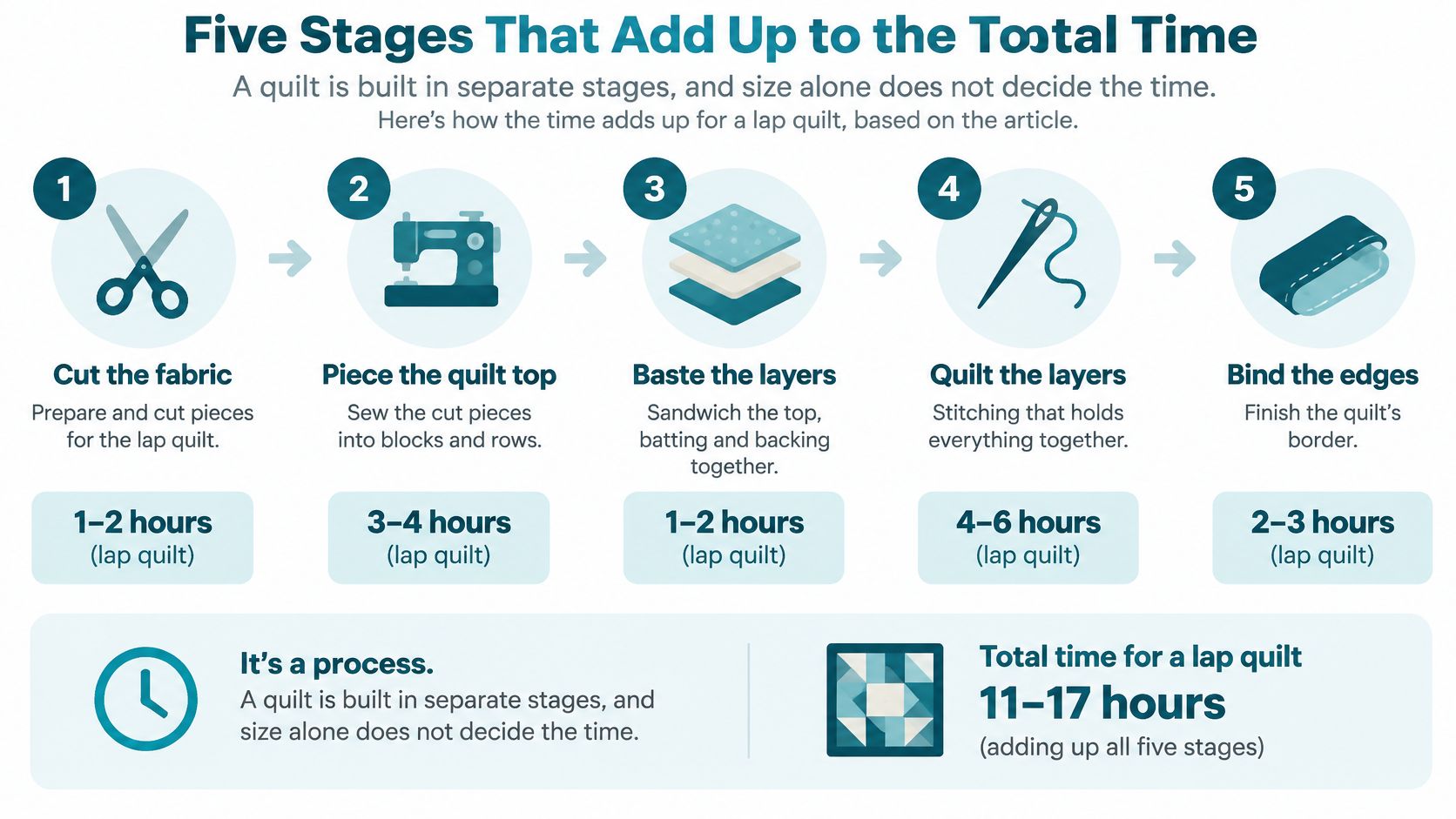
| Stage | Typical hours | What happens |
|---|---|---|
| Cutting | 2-3 hours | Sorting fabric and cutting pieces |
| Piecing the quilt top | 6-10 hours | Sewing blocks, pressing and joining rows |
| Basting | 1 hour | Layering and securing the quilt sandwich |
| Quilting | 3-6 hours | Stitching through all three layers |
| Binding | 2-4 hours | Finishing the edges |
| Total | 14-24 hours | Excludes planning |
Cutting, 2–3 hours. You sort fabric and cut strips or squares. Slow cutting here saves seam-ripping later.
Piecing the quilt top, 6–10 hours. You sew blocks, press, and join rows. This is the largest single block of time on a simple lap quilt.
Basting, about 1 hour. You pin or spray the top, batting, and backing into a flat sandwich. Rushing this stage makes the quilting fight you.
Quilting, 3–6 hours on a machine. You stitch through all three layers. That range is machine work, not hand stitching.
Binding, 2–4 hours. You fold and stitch the border. Corners take longer than the straight sides.
Piecing and quilting together run 9–16 hours, roughly 64%–67% of that listed production time. Those two stages dominate any estimate. Your bottleneck is the stage with the most hours. On a basic lap quilt, that is almost always piecing.
Estimate each stage on its own: time one block, multiply by the blocks, then add pressing, layout, basting, quilting, and binding. If you are sewing with other people, assign owners and schedule buffers the way you would on any shared build, so one slow stage does not stall the whole quilt. The batch math that turns those hours into weeks comes next, once the stages are clear.
Once the quilt top is finished, the quilting method can change the workload dramatically. A comparison from Sewing With Ease estimates about 200–500 hours to hand quilt a queen-size quilt, compared with about 4–20 hours to machine quilt one of the same size. These are hours spent quilting, not the total time to make the quilt.
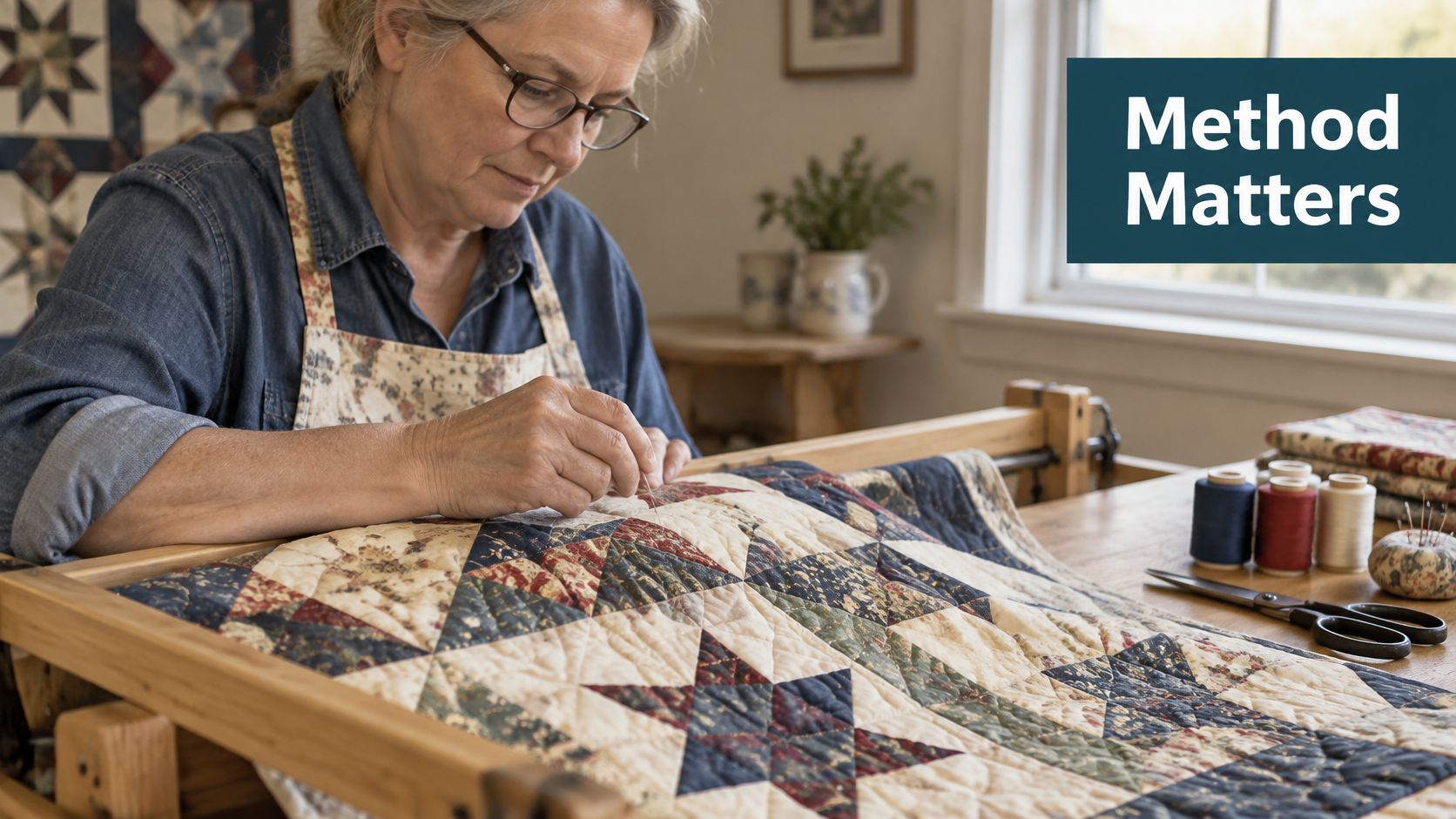
The gap comes from how each method moves the needle through the fabric. Hand quilting makes each stitch individually through the quilt sandwich. A sewing machine forms continuous, locked stitches, while a computerized longarm follows a pattern across the quilt surface. The same estimate puts a computerized longarm pantograph quilting pass at under two hours, provided the top is properly prepared.
| Quilting method | Queen-size quilting time | Best when |
|---|---|---|
| Hand quilting | 200–500 hours | Portability, visible stitch character, and a slow heirloom process matter most |
| Machine quilting | 4–20 hours | You want to finish the quilting more quickly |
| Computerized longarm pantograph | Under 2 hours | The top is properly prepared and you want automated pattern following |
These estimates cover only the quilting stage. Fabric preparation, piecing, basting, and binding add their own work, so keep “making the top” and “quilting the layers” as separate parts of your plan. The comparison is like prep work and cooking: finishing one part does not mean the whole project is done.
The method also affects how much schedule buffer to allow. Hand quilting spreads many individual stitches across your available sewing sessions, so a large quilt can take much longer in calendar time than its other stages. Machine quilting reduces the active quilting hours, but setup and preparing the quilt still matter. A faster quilting pass does not remove those tasks.
A quilt top you can piece in a month may still become a long-running project if you hand quilt every stitch. For another look at both approaches, explore a scenic pattern book with machine and hand quilting chapters.
How many weeks does a quilt take when sewing happens only in the evenings? The answer depends on the hours you can set aside, not just the time spent at the machine. A throw budgeted at 30 blocks, 45 minutes each, plus 10 hours for quilting and binding, totals 32.5 hours, conventionally rounded to 33 hours, in the worked example from Cozy Stitchery.
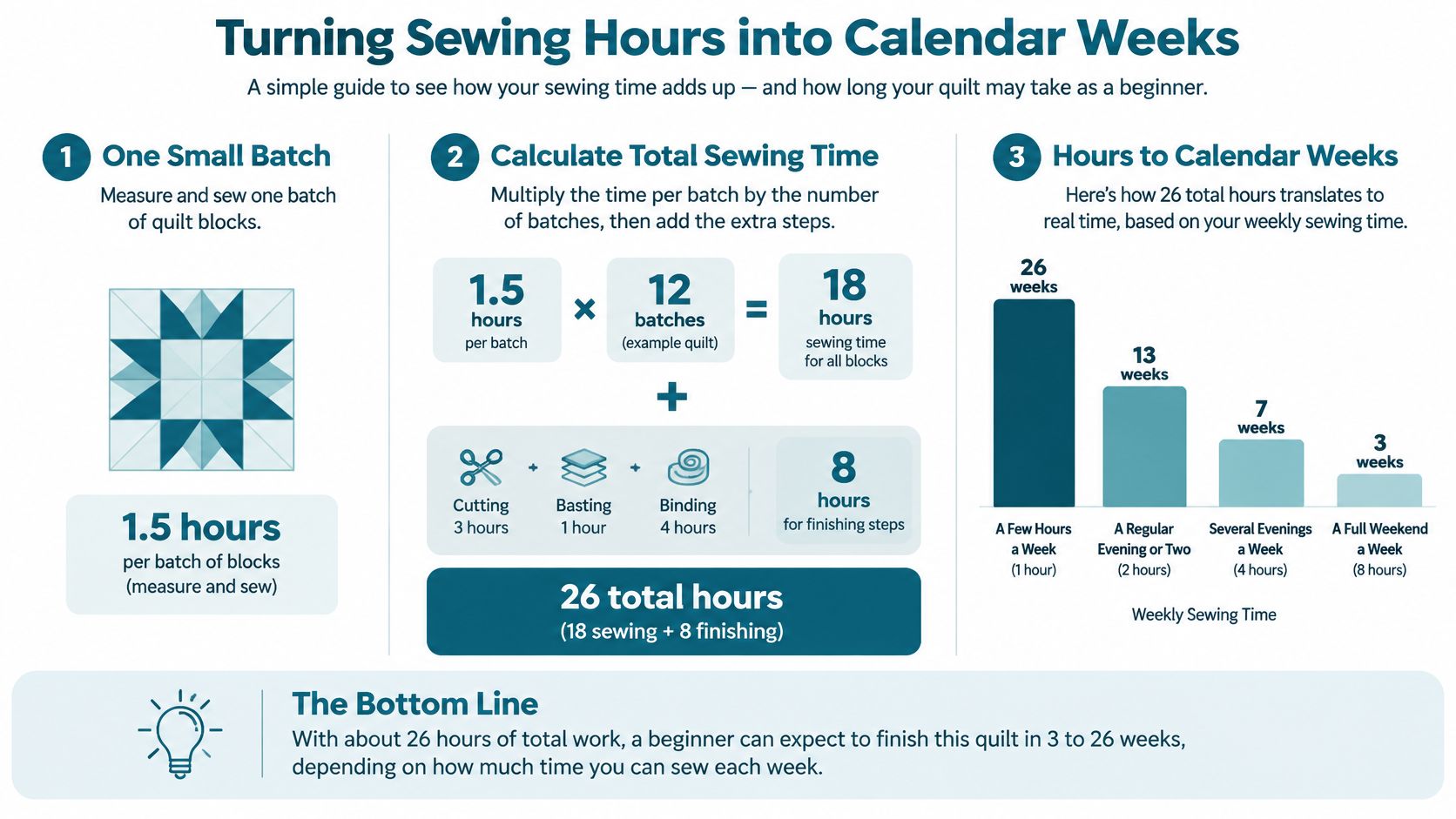
At five hours of sewing per week, those 33 active hours take about seven calendar weeks. That is the difference between prep time and cooking time: the work adds up in hours, while the calendar also includes the days between sewing sessions. An evening pace of about 30 minutes a day, or 3.5 hours a week, stretches the same project to about 9–10 weeks. At 10 hours weekly, it takes about 3–4 weeks.
A 2025 survey reported that quilters spend more than six hours per week on projects, according to American Quilter. At that pace, a 33-hour throw is near the seven-week mark, before interruptions. Fabric selection, pressing, and learning unfamiliar steps can extend the calendar, especially on a first quilt. Use your ordinary sewing week to plan: if you set aside five hours but usually sew three, calculate from three.
For a more predictable fabric-selection process, Make it Easy with 3-Yard Quilts is one option. The Make It Christmas with 3-Yard Quilts product page is another resource for festive quilt designs.
How can a quilt that takes a few dozen hours to sew occupy weeks on the calendar, while an heirloom project can span a year? The difference is easier to understand when active work is separated from elapsed time. A long project also shows why a beginner's first quilt may take longer than its pattern suggests.
One documented Grandmother's Flower Garden, pieced and quilted by hand, took an estimated 1,301 hours: about 873 hours for the top and 428 hours for the quilting, according to the maker's account on Beadlust. At a 40-hour workweek, that is more than 32 full-time workweeks of active labor. The maker spread the work across roughly one year, fitting it around work and family. The account also estimates $500 in materials. The hours show how handwork can stretch a project, but they are not a typical starting point for a first quilt.
A group can finish a shared quilt sooner on the calendar because people work at the same time. An 1862 diary entry preserved by the Encyclopedia of Arkansas records people quilting from 10 a.m. until 10 p.m. on a wedding bed quilt, which the account says was finished by 8 p.m. the next day. The example illustrates the difference between labor and elapsed time: more hands can shorten the wait, while the stitching still takes work.
Two people can follow the same pattern and need different amounts of active time. A first-timer may pause to learn each step, much as preparing ingredients and learning a recipe takes longer than cooking a familiar meal.
Strip piecing and larger pieces can shorten the build. Paper piecing, point matching, and hand quilting can lengthen it. A small quilt with intricate construction may take longer than a larger, simpler design.
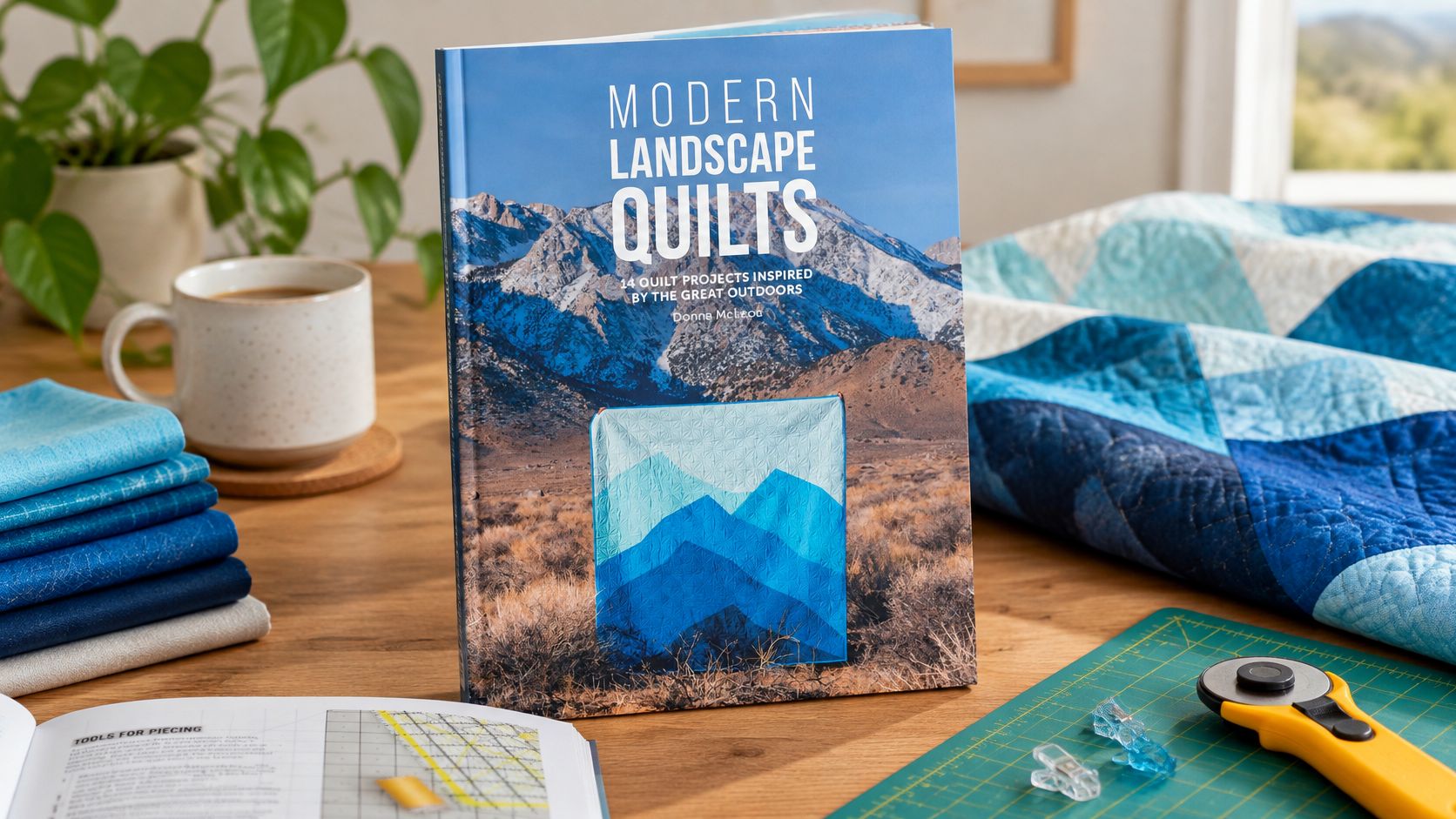
For scenic project ideas, this quilting book by Donna McLeod includes projects and guidance on machine and hand quilting. A project's design and quilting method shape its active hours; pauses between sewing sessions shape how many weeks it takes.
Before cutting, check that the quilt's active-hour estimate fits the time you can actually set aside. Then turn those hours into calendar weeks at your realistic pace. Preparation is like cooking: the hands-on time is only part of the schedule, and a planned buffer helps account for interruptions.
Use the size and method estimates from the earlier tables to choose a project. For a first quilt, a pattern with fewer small pieces can keep the piecing work closer to the lower end of its range. Choose the quilting method before settling on a timeline, since the method changes how many active hours the project needs.
Keep the two clocks separate: active sewing hours count the time you spend working, while calendar time includes the days between sessions. For the 33-hour throw, piecing accounts for the larger share of the work, with quilting adding the rest. At an evening pace, those hours can stretch across weeks, even though the hands-on total remains 33.
9-Patch Garden Quilt, created with Angie Wilson of Gnome Angel, is organized block by block. That layout offers a practical way to divide the work into manageable sessions instead of setting aside one long cutting day. High Country Quilts offers on-site quilting services, where you can finish a project with help from its experts.
For a beginner-friendly book, explore Modern Landscape Quilts. If you want size options from three one-yard cuts, consider Make It Christmas with 3-Yard Quilts. Choose the project whose estimated hours fit the weeks you have available, then make your cutting plan.
Browse patterns at High Country Quilts to find a project that fits your schedule.
November 2–25 only: buy a $200 gift card in either store and get a free yard of fabric every month of 2027.

Serger and BERNINA Mastery classes, longarm training, bag-of-the-month, Kids Sewing Club and a Highlands Ranch retreat. Here's what's on the calendar in November.

Free gifts, included packages and special pricing on the BERNINA 790 ULTRA, 990, Liberty Editions, L 890 serger and Q Series longarms, now through December 31.


Leave a comment